
Gay Slang Collection
Pato. Gay Dictionary (Latin America).
Why are gay men called pato?
In many Latin American countries, particularly in the Caribbean, the Spanish word pato (“duck”) is one of the best-known slang terms for gay men. Its use is widespread and the term has even been reclaimed by the gay community itself. However, the origin of this meaning remains uncertain.
The origin of this meaning may be linked to several associations: some related to the animal itself, such as its gait or sexual behavior, and others to the prevailing cultural views of male homosexuality at the time.
To trace this history, we will first look at when and where this usage is documented. We will then explore how the meaning may have emerged.

The duck featured in one of Moscas de Colores’ Drawings & Stories, part of the Gay Slang Collection.
When and where does this usage first appear?
Documented chronology of pato slang
The historical record allows us to establish the following chronology:
1917 (Puerto Rico). The first edition of Augusto Malaret’s Vocabulario de Puerto Rico does not list the term pato.
1937 (Puerto Rico). The second edition of Augusto Malaret’s Vocabulario de Puerto Rico defines pato as “a person who is between two waters.” The example refers to someone who changes political affiliation depending on the municipality or the circumstances.
1958–1959 (Cuba). In his Léxico Mayor de Cuba, Esteban Rodríguez Herrera lists pato with the meanings “a fool, a stupid person, an idiot, an imbecile.” In the same work, he notes that new popular terms for gay men were emerging, such as pájaro and cundango, but he does not list pato in that sense.
1966 (Puerto Rico). In the short story “¡Jum!”, included in the collection En cuerpo de camisa, Puerto Rican writer Luis Rafael Sánchez uses pato to mean “gay man.” This is the earliest known literary attestation of this meaning.
1973 (Puerto Rico). In El léxico de la delincuencia en Puerto Rico, Carmen G. Altieri de Barreto lists pato as meaning “gay man.”
1980s (Cuba). Argelio Santiesteban includes pato among the popular terms used for gay men.
1999 (Cuba). José Sánchez-Boudy’s Diccionario mayor de cubanismos lists pato as meaning “homosexual.” Work on the dictionary had begun in the 1960s.
Puerto Rico and Cuba
The chronology reconstructed so far points to Puerto Rico and Cuba as the locations of the earliest evidence and first known records of pato as a term for gay men. All indications point to the term originating in this Caribbean context, from which its use may later have spread to other Latin American countries.
This sequence should not be understood as a straightforward progression from Puerto Rico to Cuba.
During the first decades of the twentieth century, the two islands maintained close ties, marked by migration—particularly migration linked to the sugar industry—and the resulting exchange of customs, ways of speaking, and popular expressions.
These historical ties were accompanied by a shared linguistic tradition. Cuba and Puerto Rico belong to the Spanish-speaking Antilles, although they have followed different political paths since 1898. Words and their meanings do not always respect borders or spread in only one direction.
The slang term may have emerged precisely within this space of interaction, through the movement of people and words between Puerto Rico and Cuba. Rather than trying to identify a single place of origin, the earliest references suggest that both islands should be considered part of the same linguistic and cultural context in which pato was used as a term for gay men. However, they do not establish where the term originated or how it circulated between the two islands.
From clumsiness to homosexuality: a possible semantic shift
The research makes it possible to identify a chain of meanings that offers a particularly interesting explanation for the origin of this sense.
The point is not to claim that every step is documented as part of a continuous historical evolution, but to show that linguistic precedents exist from which a plausible semantic shift can be reconstructed.
From the duck’s way of walking to the clumsy person
Historical dictionaries document an association between ducks and an awkward or ungainly way of walking.
In 1875, Esteban Pichardo’s Diccionario provincial casi razonado de voces y frases cubanas records patojo, a word derived from pato, used to describe people whose feet or toes turned inward and whose way of walking was reminiscent of ducks. The dictionary also records patojear and patojera.
In Spanish more generally, a similar association is found in the adjective patoso, used to describe a clumsy, awkward, or inept person.
This relationship can be summarized as follows:
Pato (animal) → a person who walks like a duck → a clumsy or awkward person.
The characteristic observed in the animal is transferred to the person and eventually becomes a way of describing that person.
From clumsiness to a lack of intelligence
This second step is also documented.
In Cuba, Rodríguez Herrera lists pato in his Léxico Mayor de Cuba (1958–1959) with the meanings “a fool, a stupid person, an idiot, an imbecile.”
The term shifts from describing a physical difficulty with walking or clumsiness to describing someone considered unintelligent or lacking judgment.
This shift can be summarized as follows:
A clumsy person → a foolish or stupid person.
Both meanings belong to the same pejorative semantic field, suggesting a possible continuity between them.
From a general insult to one aimed at gay men: reduction to gay
Our analysis of various terms in gay slang has revealed a recurring pattern that we at Moscas de Colores call reduction to gay.
By this, we mean the process whereby a word or expression that initially describes a characteristic, behavior, or flaw that can apply to any man eventually comes to be used specifically for gay men, simply because they are gay.
The expression is intended to capture a double reduction. On the one hand, the word’s meaning gradually narrows until it applies to a single group. On the other, gay men are socially reduced to a single characteristic—their homosexuality—which society at the time regarded as inherently negative. From this perspective, any flaw attributed to a man could eventually become a derogatory term directed at gay men, who were seen as embodying every defect.
The concept of reduction to gay is not intended to establish a new linguistic category, but to name a recurring pattern that we have identified through our research into numerous terms in gay slang.
From the standpoint of historical linguistics, this pattern can be understood as the result of two processes of semantic change operating together: pejoration, through which a word acquires or intensifies a derogatory meaning, and specialization, through which its meaning gradually narrows until it specifically refers to gay men.
In the case of pato, its earlier meanings offer possible starting points for this process. “Between two waters” suggests an intermediate position, while the meanings “fool,” “stupid person,” “idiot,” and “imbecile,” along with patoso in a more indirect way, are associated with clumsiness and a lack of ability. Against this semantic background, the word may have undergone a later shift that led to its use specifically for gay men.
Similar developments can be found in other cases, such as the Spanish expression pierde aceite, the English term queer, and the French term tafiole, which we also examine in our dictionaries.
Factors that may have contributed to the emergence of the new meaning of pato
Alongside the semantic shift outlined above, other linguistic, zoological, and cultural associations may have contributed to the emergence or consolidation of the new meaning. These associations need not have been part of the word’s historical development; they may simply have been present in the popular imagination.
“Between two waters” and the “third sex”
In 1937, Augusto Malaret’s Vocabulario de Puerto Rico records pato as meaning “a person who is between two waters.” Although the example refers to political opportunism, the expression describes someone situated between two positions.
This idea of an intermediate position can be linked to a widely held conception from the late nineteenth century through much of the twentieth century: that of gay men as belonging to a “third sex.”
In the 1860s, German jurist Karl Heinrich Ulrichs, one of the earliest advocates of homosexual rights, developed a theory that placed men who loved other men in a distinct sexual category: the “third sex.” To describe this condition, he used the well-known Latin expression anima muliebris virili corpore inclusa, meaning “a female soul enclosed in a male body.”
Although Malaret uses the word pato to refer to political opportunism, the expression “to be between two waters” may have had other connotations. At a time when some sexological theories regarded gay men as belonging to a “third sex,” positioned between men and women, the expression could take on another meaning: that of being between two sexes.
We have no evidence that the two meanings were connected, but their chronological coincidence allows us to consider this possibility.
The sexual behavior of ducks
Same-sex sexual behavior in ducks was already being observed in the early twentieth century.
In 1910, German zoologist Oskar Heinroth described a pair of male wood ducks (Aix sponsa). The two had formed a bond and remained together when no females were present. When females became available again, their relationship ended.
In 1965, Friedrich Schütz published in Germany Homosexualität und Prägung. Eine experimentelle Untersuchung an Enten [Homosexuality and Imprinting: An Experimental Study of Ducks], a study examining how early learning can influence the sexual behavior of these animals.
These two works are among the most significant references in research that, from the early twentieth century onward, began documenting and analyzing same-sex sexual behavior in ducks.
There is no need to assume that these studies influenced popular speech in Puerto Rico or Cuba. Direct observation of ducks’ behavior, or the appearance of a news story or an interesting feature about them in popular magazines, illustrated publications, or newspaper columns devoted to curiosities, may have been enough to bring the association into the popular imagination and contribute to the emergence or consolidation of the new meaning.
Bird symbolism
There is also a broader connection between birds and popular terms for male homosexuality.
In the Caribbean, terms such as pájaro, pajarito, and pato are used to refer to gay men. Similar associations between birds and male homosexuality can also be found in other languages and cultures.
In his 2007 article “Queer Ducks, Puerto Rican Patos, and Jewish-American Feygelekh,” Lawrence La Fountain-Stokes examines these linguistic and cultural parallels.
Among the examples he discusses is the Yiddish term feygele, which literally means “little bird” and is also used to refer to an effeminate gay man.
These parallels show that bird names are used to refer to gay men in different languages and cultures, making this a recurring feature across different linguistic traditions.
The word pato, as used in gay slang, may have carried symbolic associations that helped it become part of this broader repertoire of terms.
Pato: A hypothesis of convergence
The research allows us to propose a possible semantic shift:
Pato (animal) → a person who walks awkwardly → a clumsy or awkward person → a foolish or stupid person → a man considered insufficiently masculine → an effeminate man → a gay man.
The resemblance to the way ducks walk may have prompted the first semantic shifts: from a characteristic of the animal to a description of a person who walks awkwardly and, later, of someone considered clumsy, foolish, or stupid.
On this basis, the two semantic-change processes discussed above may have come into play: pejoration and specialization. We at Moscas de Colores call the combination of these processes reduction to gay.
Alongside this possible development, associations with the idea of being “between two waters,” the sexual behavior of ducks themselves, and the use of bird names to refer to gay men may have contributed to the emergence or consolidation of the new meaning.
We cannot claim that this was the word’s actual historical path. However, the convergence of linguistic and cultural evidence allows us to propose an explanation that goes beyond a simple resemblance between the animal and a gay man.
Perhaps the origin of the slang term pato does not lie in a single cause, but in the convergence of several meanings, images, and cultural circumstances.
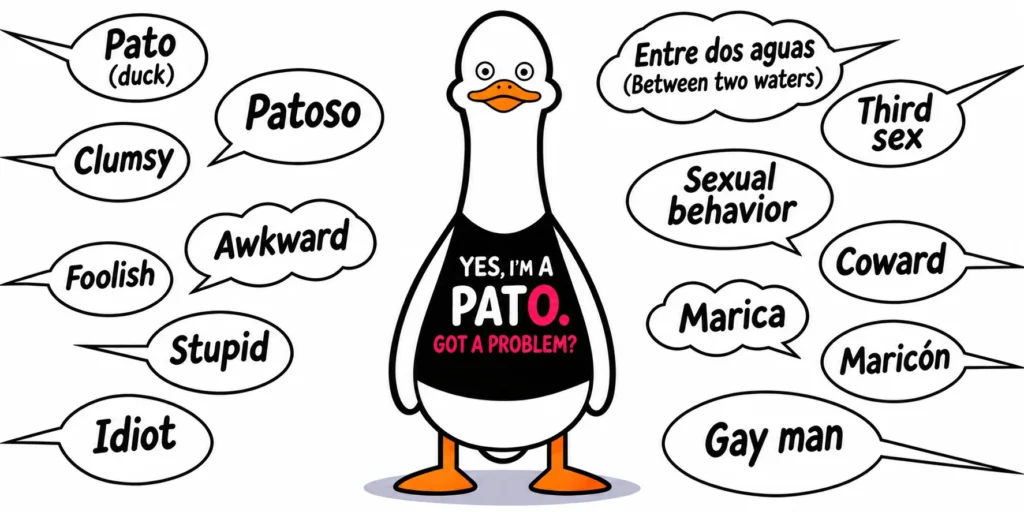
The different meanings and cultural associations that may have converged in the use of pato as a term for gay men.
Check our Spanish Gay Dictionary to learn more interesting words and stories.
Sexual diversity in Latin America according to Wikipedia.
When you purchase a Moscas de Colores design you not only help us to support this website and this project, but you also become part of the group of people that spread the words, their history and the reality that has gone with us and that still goes with us, because each of our designs is a story that you will tell and explain, an opportunity to help things get better by normalizing, visibilizing and, why not, reappropriating.

Pato. Gay Dictionary (Latin America).
Pato is a slang word used in part of Latin America to insult homosexual men, and that we have transformed into a very funny Drawing & Story, a nice paunchy duck that is one of our favorite characters. Take it in an original gay shirt and wear it with pride every day.
Other Drawings & Stories of this collection:





Do you like this Drawing & Story?
Tell us what you think about the illustration and what we tell on it. If you like it, you can purchase it printed on t-shirts and different products, to wear them with pride every day or to give to someone special for you.
Share it in your networks!