
Opinions
How many people are gay? LGBT statistics.
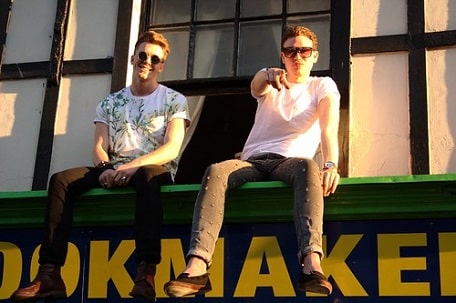
How many people are gay in the photo? one, two, three? none? Photo: Brighton Pride Party – Bookmaker by Dominic Alves used under CC BY 2.0 / resized and optimized.
How many people are gay? 1 in 10?
The idea that one in ten people is homosexual is perhaps one of the most known and recurring “myths” about homosexuality. It has become part of our imaginary, and despite having been strongly protested by certain “conservative” groups and by the every-so-often appearance of new surveys, reports, and studies that question this myth, it is difficult to leave behind because it has accompanied us since the end of the 70s, and that, for me, is my whole life.
I even remember getting surprised as a teenager, calculating “statistically” how many people in the subway, the bus, or the gym class, were “like that”. Although I also remember that at that time I never included myself in the calculation.
And even though I never considered where that comforting 10% to some and disturbing to others came from, at some point, I associated it with the figure of Kinsey and his two famous reports on sexual behavior. These reports revolutionized and scandalized the society of the 50s, removing homosexuality from the shadows and making it a relatively common phenomenon. So much so, that according to Kinsey at least 37% of the male population and 20% of the female population had had some homosexual experience between adolescence and old age.
However, in his reports Kinsey does not talk about that 10% statistics, because, although that data is related to that researcher and his report, the true fact is (at least according to Bruce Voeller, scientist and founding member of the National Gay Task Force, now known as National LGBTQ Task Force) that they “invented” the number by making an average between men (13%) and women (7%), which according to these reports were mostly homosexual. Thirteen plus seven, divided by two, equal ten.
Homosexuality everywhere
And so, the famous statistic that claimed that 10% of the population was homosexual was born. It served to support one of the major campaigns in favor of LGBT rights of the time with the slogan “we are everywhere.”
This idea that “we are everywhere”, supported by the magical 10% was a resounding success. The question How many people are gay ? was finally answered. So much so that the number, used again and again, has become an almost accepted fact, turning statistics and homosexual demography into a tool and/or a weapon in the political battlefield between defenders and opponents of the LGBT people rights. It has served as a derivative also, focusing on the thorny point that after more than a century since the concept of homosexuality appeared, it has not been possible to answer the question of what is or what is meant by homosexuality.
Because, despite having been counting homosexuals for 70 years, it seems that the authors, scholars, specialists, and experts who carry out these studies cannot come to an agreement on the matter. Each one usually uses a taxonomic model of their own, which not only determines the outcome of the research but also ends up summarizing for the general public, in more or less striking headlines that the LG, LGB, LGBT, LGBTI + population … can be both below 1% and above 20%. And while we can see this game of numbers as something almost anecdotal, the reality is that these results, as well as the parameters used to obtain them, end up being fundamental to place ourselves in relation to the rest of “normal” humanity from a socio-political, and even biological, point of view.
Homosexuality and heterosexuality, the error of approach.
Because these studies are not only about knowing how many people are gay, about how many of us are homosexual, but about why we are different, and starting from this premise of difference we are assuming and reaffirming a model of hegemonic essentialist heterosexuality that remains almost untouchable, even in these oh!-So-postmodern times
And it is based on that paradigm, that we are counted, we are studied, we are defined, we are explained and also, and perhaps above all, we are tolerated, integrated, persecuted or rejected depending on how numerous or scarce we might be.
Because it is not the same to persecute, or at best ignore, a 1% of the population as it is to do the same to this magical 10%, which made us a minority and therefore subject to rights, thanks to Kinsey, Voeller or whoever it may have been. Because that 10%, real or imaginary, assures us the right to be visible, gives us a voice. But, nevertheless, that 10% also forces us to exist in relation to a paradigm that has long since begun to sink.
The change of the homosexuality paradigm
The idea that a person’s sexuality is dynamic, fluid, changeable, and versatile, that works beyond a fixed, determinate, and stable identity that can be defined by a term, is the great secret that has existed since the times of Kinsey. It has been very hard to take in, because it implies giving up the security of labels. It implies having to face the future without the security of knowing who we are, and therefore what is expected of us.
Concepts such as sexual diversity are still applied at species level when in reality they must be applied at individual level. Sexual diversity is not something that concerns the part of the human that makes different groups of people with different characteristics, but something that must be understood as an element which is intrinsically linked to each person. It is not about how many people are gay, lesbian or bisexual. It is not that there are gay, bi or hetero humans, but that all human beings have the wonderful ability to love and enjoy in very different ways depending on the circumstances.
Counting homosexuals does nothing but reinforce that dichotomy between the normal and the different, and if we really want to move forward we must abandon that paradigm, which was useful for a time but that is insufficient today, because human sexuality, of people, of all of us, is plastic, and there is where its essentiality lies.
How many people are gay? final translation by Ruth Carballo Gallego.Tag :Heterosexuality, Homosexuality, Sexual Diversity, Sexual PlasticityAnd leave us a comment


Something to say?
Tell us what you think of this article. If it’s good or bad, if you think we are idiots, or if you see us in hell. Even if you are a few words person, to improve people’s lives, help us spread it.
Share it in your networks!