
Agender
Field: Gender Identity
Image retouched with the colors of the agender flag, green, white, gray, and black.
Photo by Kat Love from Unsplash. Colored and resized.
It is a category belonging to gender identity. Agender people neither identify as a man nor a woman. If a cisgender person is the one who identifies with the gender assigned at birth, and a transgender person is the one who does not identify with the gender assigned at birth, an agender person does not identify with either of the two. Neither with the one assigned nor with the other. When it does so partially, it is called demigender (demi-girl, demi-boy, etc.)
All these categories have a common element that is often easily assimilated when it is quite complex, and that is to identify with a gender. It is possible that, for most people, it is an unconscious process, but when we talk about agender people, we see that it is not a simple process.
People identify, or not, with what we call gender. And this complicates the issue a bit more. Gender, the concept of man, the concept of woman, the masculine, and the feminine, are nothing other than social constructions. What is typical of men and women today was not so in the past, nor will it be in the future. What was not typical of men in the USA was normal in Papua New Guinea. The gender changes with time and space.
So people, when we are born, are assigned something relative, a gender, as if it were really absolute, immovable, and imperishable. If we don’t dislike it, we stay as we are. If we dislike it, we change. But What if we don’t like any of them?
For a while, we will do whatever we want, behave as we please, and dress as we like, but from a moment on, we will suffer a constant confrontation with what our gender is supposed to be and what it is not supposed to be. That is gender surveillance. Our environment will say, this is a girl and this is a boy, and agender people will not see themselves either as one or the other. And it may be that way forever, or it may change over time.
Read also: The sexual behavior of the Sambia.
See also: Purple Unicorn, youtube channel by Nick.
Allosexual
Field: Sexual orientation
Asexual or Allosexual? Judging from what we see in this photo, these people could be both Allosexual and Asexual, we cannot deduct one thing or the other.
Couple. Photo by Brian Crawford. Used under CC BY 2.0/resized and optimized.
Allosexual is a category belonging to sexual orientation (understood in a broad sense, not only to whom it is oriented, but also to how it is) that, by definition, is opposite to the concept of asexuality. An Allosexual person is one who feels sexual attraction to other people and needs sexual interaction with other people, and an asexual would be the opposite.
You might think that the term Asexual would have its opposite in the word “Sexual.” However, this pair of concepts (sexual-asexual) would not express very important nuances to understand what asexuality really is. Asexuality does not imply the lack of sexuality, but the absence of erotic attraction and the need for sexual interaction with other people.
Allosexual is a neologism created with the Greek root Alo- (ἄλλος) that would have the meaning of another. Sex with another person (with someone other than myself). Thus, asexual people can, for example, have sexual fantasies, masturbate and feel pleasure, that is, they have a sex life, but not necessarily with other people. Similarly, asexual people can have emotional relationships, sex with their partners, and kids. We are talking about attraction and need for sexual interaction, not about lacks, deviations, problems, dissatisfaction or, unhappiness.
Allosexual, it is a term that has some similarity with the expression Cisgender, which is created to designate people who are not transgender, thus avoiding the exclusionary concepts of “normal” or “majority.” Therefore, the Allosexual concept serves to be able to speak correctly of people who are not Asexual in the field of the study and diffusion of sexual diversity.
Androgyny
Field: Gender expressionAn androgynous person has a mixture of masculine and feminine gender expression. Even today, Androgyny is confused with hermaphroditism when both concepts refer to very different components of Sexual Identity. The last concerns the biological sex, which classifies people as female, intersexual (related to hermaphrodite), or male. The first relates the gender expression, which classifies people, regardless of the biological sex, as masculine, feminine, or androgynous.
Asexual
Field: Sexual orientation
Asexual flag.
It is a category belonging, not without discussion, to the sexual orientation. An asexual person is one who does not feel sexual attraction for anyone and who has no or little interest in sexual activities. This does not include affective relationships, since an asexual person can, for example, fall in love. The lack of sexual attraction does not prevent them, however, from having sex with their partners, to please them or to have children. Asexuality is also sometimes referred to by the English expression “ace”. The opposite concept of asexual would be allosexual.
Bigender
Field: Gender Identity
Bigender flag, composed of stripes of different shades of pink (female gender) and blue (male gender), in the center a white (neutrois) stripe.
When we talk about bigender, we are referring to one of the components of a person’s Sexual Identity that is gender identity. We are not talking, therefore, about biological sex, or sexual orientation, or gender expression, but we talk about what and how a person feels the identity is concerning the gender.
To explain it easy, we will start with the binary sexual system. Many people identify themselves only as women or as men (what we might call mono gender), but other people identify with more than one gender. In this sense, we could say that a bigender (or dual gender) person feels both as a man and as a woman, and this can be in different magnitudes, which can change over time.
The above definition falls short when we look at reality, so we must introduce the non-binary sexual system to pay attention to people with two gender identities that can be binary (male/female) and non-binary, for example, agender ( they do not identify with any gender), gender fluid (at some point is identified with one gender and at other times it is identified with another.), or any other identity. The same applies to Trigender people, who identify with three gender identities, whatever they may be.
Finally, we must bear in mind that we are talking about a subjective perception, how we feel our gender, and not how we express that gender. In this sense, when we meet someone, we could not say without any fear of being wrong, that this person is bigender, agender, transgender, genderfluid, pangender, demi gender, etc. And you also have to remember that words like bigender, are categories created to talk about what already happens and not the contrary.
Binary sexual system
Field: Queer theoryThe binary sexual system or model, is a traditional classification of people sexuality that establishes two strictly delimited and excluding categories for four of the five main components of Sexual Identity. Female, male, woman, men, feminine, masculine, homosexual and heterosexual are their categories.
This system is used as a normative by certain sectors of society that consider deviation, abnormality or pathology, any manifestation of sexual diversity that does not adjust those categories (excluding homosexuality, of course).
However, from a pedagogical point of view, it is useful to begin to explain human sexuality and as a model to overcome, being replaced by the non-binary sexual system.
Biological sex
Field: Sexual IdentityDefinition
Biological sex is the classification of a person as male, female, or intersex based on their bodily characteristics.
Explanation
Biological sex is one of the components of sexual identity and is based on a combination of factors such as chromosomes, hormones, internal reproductive organs, and genitals. Although these elements are usually related, they do not always align with one another.
At birth, a sex is assigned to a person according to visible bodily characteristics, generally without a complete analysis of factors such as chromosomes or hormones. In some cases, especially in intersex people, this assignment may not reflect the full biological complexity of the person.
This system makes it possible to classify people, although it does not always capture the full complexity of biological variation.
Types of biological sex
Biological sex is commonly classified as:
- Male
- Female
- Intersex
These categories help describe biological sex, although they may include a wide diversity of variations.
Relationship with other components
Biological sex is one of the components of sexual identity.
It is related to:
- Gender identity → is not directly determined by biological sex
- Sexual orientation → does not depend on biological sex
- Gender expression → does not necessarily match assigned sex
- Sexual behavior → is not determined by biological sex
Common misconceptions
Understanding biological sex requires avoiding some oversimplified or inaccurate ideas that are still common.
Among the most frequent are:
- Believing that biological sex automatically determines gender identity
- Confusing biological sex with gender identity
- Assuming that only two completely fixed biological categories exist
- Ignoring the existence of intersex variations
Recognizing these distinctions helps foster a better understanding of sexual diversity and the complexity of human experience.
In the sexual identity model
In the sexual identity model developed by Moscas de Colores, biological sex is one of the five components of sexual identity that give rise to sexual diversity. Its combination with the other components gives rise to very different experiences and forms of sexual diversity.
Example
Two people with the same biological sex may have:
- different gender identities
- different sexual orientations
- different forms of gender expression
This shows that biological sex is only one part of sexual identity.
Conclusion
Biological sex describes a set of bodily characteristics, but it does not by itself define a person’s identity. Understanding it within a broader framework, such as sexual identity, helps avoid confusion and encourages a more complete understanding of sexual diversity.
Continue exploring sexual identity
Next component: 👉 Gender identity
Biphobia
Field: SocietyIn a strict sense, biphobia means fear or hate that is felt towards bisexual people. But to fear and hate, we would add contempt.
Bisexual
Field: Sexual orientation
Bisexual flag.
It is a type of sexual orientation. A person wich sexual orientation is bisexual is the one who feels physical, emotional, and/or romantic attraction towards people of two genders and/or sexes, not necessarily at the same time, in the same way, at the same level, or with the same intensity. It does not mean that bisexuals have sex with both sexes, or that are promiscuous. In fact, it is not necessary to have any kind of sex to self-identify as a bisexual person.
There is some discussion and accusations regarding the bisexual, omnisexual, and pansexual categories. The dispute revolves around the people who think that the Omni and Pansexual categories are, in fact, bisexuality. But this is a taxonomic question; Bi are two, Omni are all (genders/sexes), and Pan is any (person.) The difference between bisexuality and omnisexuality is a matter of quantity and the difference between bisexuality and pansexuality is a matter of quality.
Black triangle
Field: SocietyThe Black Triangle is the symbol in Nazi concentration camps, that identified lesbians, prostitutes, women without children and those with “antisocial” quirks, leading away from the traditional model of a woman. Then it was used by the lesbian and feminist activism.
Bottom
Field: Sexual behaviorWhen we are talking about gay sex, the bottom is the passive part in anal intercourse, is the man who is penetrated anally with the other man’s penis. Depending on the role chosen for sex, gays define themselves as top, bottom or versatile, being the latter ones those who play both roles. The adopted role can be fixed forever, although it can also change with time and circumstances. It is not very clear what are the determinants of the role that each one acquires, but the different consideration that tops had for a long time regarding the bottoms may have some relation, in this sense during the Roman Empire the homosexual behavior of the men did not suppose any problem as long as the active role was adopted, while the bottom role was rejected both in penetration and fellatio, because it was related to women. It is also true that the fear of pain that may cause penetration can be a barrier to adopt the bottom role, a fact that may explain that versatility increases with age and experience. Anatomically the body of all men is prepared to feel pleasure being penetrated.
Synonyms: Catcher.
See: Pedicabo ego vos et irrumabo. The Catullus poem.
Bromance
Field: Relationship
Some suggest that the term Bromance began to be used among skaters and surfers.
Photo: Bromance, by Todd F Niemand, used under CC BY-NC 2.0 / resized and optimized.
Bromance is the love that unites two, or sometimes more, straight men. It is said that this expression was coined in the 1990s by Dave Carnie, editor of the Skateboarding magazine Big Brother. It described the intimate friendship that sometimes linked two skaters who spent a lot of time together. This term, composed of the words brother and romance, began to enjoy popularity around 2005 with its emergence in cinema and television, making visible the changes occurring in Western masculinity, immersed in the metrosexual phenomenon. In this kind of relationship admiration, trust, and loyalty are absolute, and there are also hugs and loving expressions, but no theoretical attraction or sexual activity by definition, because at that time the g0y man also emerged, who starts his relationship with a bromance.
Read also: g0y, not gay (article in our blog)
Cisgender
Field: Gender IdentityIt is a term used to classify people whose gender identity and biological sex are concordant, and whose gender expression is also concordant with that socially are assigned to this biological sex. For simplicity, we can say that there are transgender people and people who are not, and those that are not, are called cisgender.
Demigender
Field: Gender Identity
Demigender flag.
It is a category pertaining to gender identity. A demigender person feels identified as a man or as a woman, but in a partial way. Demigender people can be named as demiboy, demigirl, etc.
Demisexual
Field: Sexual orientation
Demisexual flag.
It is a category that belongs to sexual orientation. A demisexual person is one who only feels sexual attraction for people with whom he has previously established a strong and lasting affective bond. They are people who, in the absence of this bond, behave like asexuals. Demisexual people can be classified as demi-heterosexual, demi-homosexual or demi-bisexual. Likewise, demisexuality can be classified as a type of graysexuality that is, in turn, a type of asexuality.
G0y
Field: Sexual behavior
The g0y flag relates blue to masculine.
The term g0y, pronounced g-zero-y, appeared around 2005 in the United States to name the man who, regardless of his sexual orientation (homo, hetero, or bi), has erotic-affective relationships with men in which anal sex is excluded, which extends to their wives, girlfriends or female sexual partners. Zero with the anus. This phenomenon has had great success in Brazil, where we can find G0Y groups, pubs, and private parties. This glossary entry on this curious masculinity only reflects a minimal part of reality. If you are looking for more detailed information, read the article published on our blog.
Variations: Goy, G-zero-ypsilon, Heterog0y, Heteroflex, Soft-bi.
Related: Bromance.
Gay
Field: Sexual orientationIt is the most universal and internationally way to appoint homosexual men, that is, men who show inclination towards erotic and emotional relationship with individuals of the same sex. It is an English loan that has its origin in the Provencal word “gai” that means happy and rascal. Over time began to be used to name prostitutes, and after, as happend with other terms, came to be used against feminine men and men who could be homosexuals. Over time and in response to the term “homosexual”, turned into pathology, the word gay was chosen by the LGBT community to refer to themselves, stripped of its negative connotations.
Gender
Field: SexualityGender is a social category that comprises a set of characteristics assigned to people at birth, based on their known biological sex. This set of characteristics are features, functions, and valuations that will depend on the space and time in question, so that gender is a social construction and not an essentialist issue linked to biological sex. This construct is learned and assimilated through socialization, and with it, we will build our Identity. It is a process that lasts a lifetime, so it will change along with your Expression.

Too Queer for your binarism. A written text on a wall in the center of Valencia, to take into account when reflecting on gender. Photo by Moscas de Colores.
Taking the simplistic Binary Sexual Model, when born, the person with Male biological Sex is assigned the Masculine Gender. With just this simple act, until recently, people always expected that his Identity would be Man, that his Expression would be masculine, and that his Sexual Orientation would be towards women.
This psycho-biological determinism, still so widespread today, has an effective control tool named Gender Surveillance, which is responsible for correcting deviations. So if a man shows a characteristic belonging to the feminine gender, it is most likely that his environment will be in charge of correcting him, through a comment, mockery, or an insult. That is why the surveillance is behind many very common insults today, such as Pussy and Tomboy.
The gender, it may be the first software installed on our hard drive, allow the simile.
We recommend you to read our article Sexual Identity, and then that of Tomboy and gender expression, articles that you can find in our blog.
Gender binarism
Field: Queer theorythe gender binarism establishes exclusive categories, male and female, masculine and feminine, in which all people should be classified and self classified, and also established in each historical moment the characteristics that define each category. When someone shows some distinct feature, the gender vigilance appears and attempts to correct the deviations.
Gender dysphoria
Field: Gender IdentityDysphoria is the opposite of euphoria, so gender dysphoria is disgust, displeasure, imbalance or discomfort that a person can feel with the biological sex that has corresponded. Gender dysphoria is related to transgender and transsexual people, but they are different things, as there are among these people, who do not feel it.
Gender expression
Field: Sexual IdentityDefinition
Gender expression is the way a person presents their gender through appearance, behavior, and self-expression.
Explanation
Gender expression is one of the five components of sexual identity and refers to the visible aspect of a person: how they present themselves and how they are perceived by others.
It includes elements such as clothing, hairstyle, body language, voice, gestures, interests, and behavior. In simple terms, it is how others interpret a person based on what they perceive.
Gender expression is influenced by social and cultural norms that define what is considered masculine or feminine, and how expressions that do not clearly fit into either category are interpreted. These norms may be external (what society expects) or internal (what each person assumes or chooses for themselves).
Between masculinity and femininity, there is a continuum of expression with many degrees and nuances.
In this context, this gives rise to what is known as gender vigilance: a set of social practices that seek to correct or limit gender expressions that do not conform to these norms. This vigilance may come from the social environment or from the person themselves, and it contributes to reinforcing gender binarism.
In addition, gender expression is not fixed: it may vary over time, depending on context or personal decisions, and it does not always align with gender identity or biological sex.
Types of gender expression
Different forms of gender expression include:
- Masculine
- Feminine
- Androgynous
In androgynous people, gender expression is a mixture — which may vary — of traits considered masculine and feminine.
These categories are simplifications of a more diverse reality.
Relationship with other components
Gender expression is one of the five components of sexual identity.
It is related to:
- Gender identity → does not always match the way it is expressed
- Biological sex → does not determine gender expression
- Sexual orientation → is independent of gender expression
- Sexual behavior → is independent of gender expression
Common misconceptions
Understanding these ideas is key to avoiding common misunderstandings.
Some misconceptions about gender expression are common:
- Thinking that gender expression necessarily reflects gender identity
- Associating certain ways of dressing or behaving with a specific sexual orientation
- Reducing gender expression to rigid stereotypes of masculinity or femininity
- Considering gender expression to be fixed and unchanging
Identifying these misconceptions helps foster a better understanding of sexual diversity.
In the sexual identity model
In the model proposed by Moscas de Colores, gender expression is part of the set of components that make up sexual identity. The way it relates to the other components influences how each person expresses their identity.
Examples
A person may:
- identify as a woman
- have a gender expression considered masculine
- have any type of sexual orientation
Two people with the same gender expression may have:
- different gender identities
- different sexual orientations
- different sexual behaviors
- the same or different biological sex
This shows that gender expression is independent from other components of sexual identity.
Conclusion
Gender expression is the visible way a person shows their gender and how they are perceived by others. Understanding it as part of sexual identity helps avoid stereotypes and better understand the diversity of ways people exist and express themselves.
Related components of sexual identity
- Previous: Gender identity
- Next: Sexual orientation
Gender identity
Field: Sexual IdentityDefinition
Gender identity is the way a person perceives and identifies themselves in relation to gender. It may or may not align with the biological sex assigned at birth based on visible genital characteristics.
Explanation
Gender identity is a central dimension of sexual identity and refers to the internal, deep, and personal experience of gender.
It does not necessarily depend on:
- biological characteristics (biological sex)
- attraction to other people (sexual orientation)
- the way a person expresses themselves externally (gender expression)
It is a subjective experience that can take many forms and does not always fit within binary categories such as man or woman.
Types of gender identity
Some types of gender identity include:
- Man
- Woman
- Non-binary
- Gender-fluid
- Agender
These categories help describe reality, although they do not encompass it completely.
Relationship with other components of sexual identity
Gender identity is one of the components of sexual identity and is related to other elements, although it does not depend on them:
- Biological sex → does not determine gender identity
- Sexual orientation → is independent of gender identity
- Gender expression → does not always match gender identity
- Sexual behavior → does not define gender identity
Understanding these distinctions is key to avoiding confusion.
Relationship with assigned gender at birth
Depending on the relationship between gender identity and assigned gender at birth, terms such as the following are used:
- Cisgender → when they align
- Transgender → when they do not align
These terms do not describe gender identities in themselves, but rather the relationship between different components of sexual identity.
Common misconceptions
It is common to confuse gender identity with other related concepts. Some frequent misconceptions include:
- Thinking that gender identity depends on biological sex
- Associating gender expression with gender identity
- Assuming that gender identity is linked to a specific sexual orientation
- Believing that all people experience gender identity in the same way
Understanding these ideas allows for a more precise understanding of sexual diversity.
In the sexual identity model
Within the sexual identity model, gender identity interacts with the other components, shaping very different personal experiences and forms of self-identification.
Example
Two people with the same gender identity may have:
- different sexual orientations
- different forms of gender expression
- different sexual behaviors
This shows that gender identity is only one part of the whole.
Conclusion
Gender identity describes how a person perceives themselves in relation to gender, but it does not by itself define their complete identity.
Understanding it within a broader framework, such as sexual identity, helps avoid confusion and encourages a more complete understanding of sexual diversity.
Related components of sexual identity
- Previous: Biological sex
- Next: Gender expression
Gender vigilance
Field: Queer theoryThe gender vigilance is a social tool that tries to suppress or modify any gender expression that not correspond to the gender assigned at birth. Parents, educators, environment, and even each of us, perform gender vigilance, and its intensity vary with age and sex. Gender vigilance tends to reinforce the so-called gender binarism.
Genderfluid
Field: Gender Identity
Genderfluid flag.
It is a category pertaining to gender identity. Genderfluid people are those who in a few moments feel identified as a man, and at other times as a woman.
Graysexual
Field: Sexual orientation
Graysexual flag.
Graysexual, also named greysexual, grey-asexual, gray-asexual, grey-A, gray-A, grey-sexual, gray-ace, grace, it is a category that belongs to the sexual orientation. A graysexual person is one who only feels sexual attraction on very specific occasions. The use of the word gray /grey is related to the illustration that can be done to expose the categories so that in the white area would be the allosexual people (those who feel sexual attraction) and in the black area the asexual people (those who do not feel sexual attraction), then graysexual would be at some point of the Gray Zone.

Illustrative graphic of graysexuality. Greysexual people are in the gray zone.
This graphic, in addition to placing people based on their sexual attraction, also tells us that, like everything related to human sexuality, it is a matter of degree but also of fluency, since we will not be all our lives at the same point. In front of the traditional vision of sexuality, being categorized in separate, closed and, determined compartments, the sexual plasticity defines much better how our sexuality is.
Types of Graysexual
It can be considered that there are several types of graysexuality depending on the type of specific circumstances in which is felt sexual attraction, so is called fraysexual the person who could be sexually attracted to people who barely knows, and that when are known the sexual interest is lost, is a person that only feels primary sexual attraction; is denominated akoisexual the person who feels sexual attraction by another just until begins to be corresponded, moment in which loses the interest; and reciprosexual, the person who can begin to feel sexual attraction by a person when realizes that arouses sexual desire in that person. Some people consider demisexuality as a type of graysexuality since they only feel secondary sexual attraction, that is when they have a strong emotional bond with the other person.
Heteronormativity
Field: Queer theoryThe Heteronormativity may be the pretension, even unconsciously, that the pattern to be followed by everyone is the heterosexual, in any aspect of life.
Heterosexism
Field: Queer theoryAfter 2000 years of homophobia whole society was articulated from heterosexuality. And the world was divided between the good straight and the devil (not straight). This heterosexism can also be seen as heterocentrism, affecting even science. In many investigations of animal species, it is assumed that the couples studied were formed by a male and a female, when in fact they were studying homoparental couples. Heterosexism are polarized glasses.
Heterosexual
Field: Sexual orientationIt is a type of sexual orientation. Man or woman whose physical and emotional attraction is directed towards people of the opposite gender. Heterosexual term appears at the same time the term homosexual, in the late 19th century, from the pen of a Hungarian poet and writer named Karl-Maria Kertbeny in a public letter urging the authorities to decriminalize homosexual behavior. Before that date there was no heterosexual or homosexual, there were normal people on the one hand, and sinners – criminals on the other.
Homoparentality
Field: RelationshipThe paternity of homosexuals. So a homoparental couple is a homosexual couple who have children, adoptive or not. Bridging the gap and for information, homoparentality is not unique to the human species, also it occurs in other species.
Homophobia
Field: SocietyHomophobia is fear or hatred of gay men and lesbian women. The word prejudice, may be more accurate to describe antipathy towards LGBT people.
Homosexual
Field: Sexual orientationIt is a type of sexual orientation. Man or woman whose physical and emotional attraction is directed towards people of the same gender. The term appears, at the same time than heterosexual term, in the late 19th century from the pen of a Hungarian poet and writer named Karl-Maria Kertbeny in a public letter urging the authorities to decriminalize homosexual behavior. Before that date there was no heterosexual or homosexual, there were normal people on the one hand, and sinners – criminals on the other. Although the term was created with good intentions, in the end it was very successful in the world of medicine and psychiatry and thus began the stage of pathologizing, where homosexuality ceased to be a crime, to become a mental illness. That is why the LGBT collective replaced it by the word gay, to remove the smell of electro-convulsive hospital. Today it is used normally without the negative charge.
Homosexual behavior
Field: Sexual behaviorHomosexual behavior is the sexual relationship between people of the same sex (sorry about the binarism), in the same way, heterosexual behavior is that which occurs between people of the opposite sex. Which we can extend to almost the entire animal kingdom. Nothing new here, right?
Talking about homosexual behavior deserves special interest if it is to differentiate it from homosexuality. They are related but different aspects. Of a homosexual people, we can expect them to have homosexual behavior, but this does not prevent in any way, that they have sexual experiences with people of the opposite sex, and vice versa. Likewise, a heterosexual person does not become homosexual or bisexual by having sexual contact with a person of the same sex. This highlights the current identity conception of homosexuality: I am homosexual. A conception that did not exist until the end of the 19th century when the term was invented. What was there before? Many things, however, what we know for sure, is that there was homosexual behavior, no matter how much we go back in time.
Distinguish these two concepts is essential if we want to understand human sexuality, because the behavior is comparable, because focusing on homosexual behavior, and not on homosexuality, we can understand where it comes from and what its role is.
See: Mostacero. Gay Dictionary (Peru)
Read more: Homosexual behavior and homosexuality (Post from our blog)
Read also: What is homosexual? (Post from our blog)
Intersexual
Field: Sex
Intersexual flag.
The person who has physical characteristics of both sexes. The intersexuality is a category belonging to the biological sex, existing many genetic, hormonal or anatomical variations that can make the intersexual sex, notwithstanding these variations have to be interpreted as errors. The debate about intersex is intense because traditionally, in some cases, parents and doctors tended to choose the baby’s sex. The process involving constant surgery and suffering, and ultimately did not have to correspond with the gender identity of the person. There are other options, such as living life, and that the sexuality will be defined over time if it is needed.
Lesbian
Field: Sexual orientationIt is the most universal way to name homosexual women, ie women who show an inclination for erotic-affective relationships with people of the same sex. The word lesbian has its origin in the name of the Greek island of Lesbos, where the poet Sappho lived in the 5th century BC, whose literature focuses on the beauty of women and the proclamation of her love for them.
LGBT
Field: SocietyAcronym used for “Lesbian, Gay, Bisexual and Transgender.” Following the inclusive spirit terms and its letters can be added, as LGBTIQ, LGBT +
LGBT pride
Field: Society
LGBT Pride flag.
It is the commemoration of the day when everything changed on June 28, 1969, with the Stonewall riots. The following year the first LGBT pride event was held in New York and nowadays pride is celebrated in thousands of cities around the world, is a key element in the visibility of sexual diversity.
Read more: Stonewall Inn, the origin of LGBT Pride.
Love
Field: RelationshipThe cultural production about love is infinite, so, to avoid getting lost, we are left with the essentialist definition of Eduard Punset, which defines it as “fusion instinct.”
But fusion with one or more people? Most societies have established monogamy as a model of relationship and fidelity in the couple as an essential requirement, however in these same societies polygamy and infidelity are common. Can the human being to love more than one person? The answer is in polyamory.
Non-binary sexual system
Field: Queer theoryThe non-binary sexual system or model is a classification of human sexuality that does not establish delimited and excluding categories for the components of the Sexual Identity and, therefore, better classifies all manifestations of human sexual diversity.
Unlike the binary sexual system, used by some sectors as normative, it helps us to understand the different sexualities integrating all of them without consider deviations, abnormalities or pathologies.
Taking sexual orientation as an example, between the homosexual and heterosexual categories, this model not only includes bisexuality, but also establishes a continuum between those two poles in which people can move throughout their lives, and not only this, but integrates other manifestations of sexual orientation such as, among others, pansexuality and asexuality.
The main implication of the non-binary sexual system is that human sexuality is plastic, so that, in the limit, there can be as many sexualities as there are people on the planet.
Omnisexual
Field: Sexual orientation
Omnisexual people like all genders and sexes.
Brighton Pride Party – No tittle, by Dominic Alves utilizada con CC BY 2.0 / redimensionada y optimizada.
It is a category that belongs to sexual orientation. An omnisexual person is one who feels an erotic-affective inclination for people of any gender or sex, being this gender or sex, determinant in the attraction.
The difference between omnisexuality and pansexuality lies in the fact that a pansexual person does not take gender or sex into account when attracted to someone, focusing on other characteristics, whatever these may be. To give an example, pansexual people can feel attracted to a smell, a voice, humor, strength …anything. For them, sex and gender are secondary aspects. Omnisexuals and pansexuals are differentiated by the role played by gender and sex in the attraction.
Similarly, omnisexuality and polysexuality are distinguished by a quantitative issue. A polysexual person may have no interest in any particular gender and/or sex (or some) but may have in the rest of them. For example, a polysexual man may be attracted to cisgender women, transgender women, transsexual women, and demigender women, but not to men or to the “masculine”, whereas an omnisexual person may be attracted to any type of person, being its gender and sex determinant in the attraction, and this omnisexual person likes each and every one of them. A polysexual person likes more than 2 genders and/or sexes, but not all of them.
It is small nuances (but big at the same time) that differentiate these terms, which do nothing but describe what these people feel. In addition, it is necessary to make clear that being omnisexual, pansexual and polysexual does not obviously mean that you are interested in threesomes, orgies, etc., or that you are not monogamous, or that you are attracted to the whole world, at any time. We are talking about what attracts them, not about what they do.
Final English translation by Ruth Carballo Gallego.
Pansexual
Field: Sexual orientation
Pansexual flag.
It is a category that belongs to sexual orientation. A pansexual person is the one who feels the erotic-affective inclination for people regardless of their gender identity, gender expression or biological sex, whatever they may be.
Pink triangle
Field: SocietyIn the Nazi concentration camps people was classified with a triangle, exhibited sewn on clothes. Pink triangle was assigned to gay men.
Polyamory
Field: Relationship
Polyamory flag.
Polyamory is a type of personal relationship, included in the so-called non-monogamy, ethical and consensual relationships, which consists of having more than one sexual and emotional relationship at a time. Polyamory can be classified as hierarchical or non-hierarchical, depending on the prevalence or not, of one of the couples over the others. Another type of non-monogamous relationship would be, for example, the partner swapping or swinging.
Polysexual
Field: Sexual orientation
Polysexual flag.
It is a category that belongs to sexual orientation. A polysexual person is one who feels erotic-affective attraction for people whose gender and/or sex can be classified into more than two categories. If a bisexual person feels the erotic-affective inclination for men and women, which would be two categories, a polysexual person is attracted to some other category, for example, agender people and/or bigender people.
Queer theory
Field: Queer theoryThe Queer theory is one of the most fascinating and complex issues of all the LGBT cultural construction. The idea is that states that all aspects of sexual identity are social constructs embodied in labels such as male, female, straight, gay, lesbian, transgender, etc. From here borns the Genderqueer, which is also a label to advocate for the elimination of lables. In Queer talks there is much mixture explaining how human sexuality works, with how sexuality should be. Queer means twisted, and this supposed the appropriation of the term, until then used to mark and insult, to transform it into a big protest concept.
Sexual Behavior
Field: Identidad SexualDefinition
Sexual behavior refers to the practices, desires, thoughts, and fantasies related to a person’s sexuality.
Explanation
Sexual behavior is one of the five components of sexual identity and refers to how a person experiences their sexuality, both in practice and in the imagination.
It includes what a person does, desires, imagines, and also what they reject. In simple terms, it is the way each person experiences their sexuality.
It encompasses a wide diversity of practices and experiences. These may include, for example, sexual relationships with other people, masturbation, sexual fantasies, the consumption of pornography, or the absence of sexual activity. It also includes specific practices such as bondage, sadomasochism, partner swapping (swinging), cross-dressing in sexual contexts, fisting, or golden showers, among many others.
Sexual behavior is not determined by a single set of norms, although it may be influenced by social, cultural, or personal factors that shape which practices are accepted, hidden, or rejected.
In addition, sexual behavior is not fixed: it may vary over time, depending on context or personal experiences, and it does not always align with sexual orientation, gender identity, or biological sex.
Homosexual behavior and homosexuality
Homosexuality and homosexual behavior are related, but distinct, concepts.
Homosexual behavior — relationships or practices between people of the same sex — has always existed, both in humans and in other species. Homosexuality, by contrast, is a historical and cultural way of naming and interpreting that reality within the framework of sexual orientation. This means that a person may engage in homosexual behavior without identifying as homosexual.
You can explore this distinction further in our blog article.
Dimensions of sexual behavior
Sexual behavior can manifest in many different ways. Its dimensions include:
- With whom it takes place, whether with other people or alone
- The sexual practices involved, conventional or less conventional (such as BDSM or fetishes)
- The type of emotional or relational bond in which it develops
- The frequency or existence of sexual activity, which may be frequent, occasional, or absent during certain periods
These categories are simplifications of a much more diverse and changing reality.
Relationship with other components
Sexual behavior is one of the five components of sexual identity.
It is related to:
- Sexual orientation → does not always align with sexual practices
- Gender identity → does not determine sexual behavior
- Gender expression → does not define how sexuality is experienced
- Biological sex → does not determine sexual practices
Understanding these ideas is key to avoiding common misunderstandings.
Common misconceptions
Some misconceptions about sexual behavior are common:
- Thinking that sexual behavior defines sexual orientation
- Assuming that certain practices correspond to a specific gender identity
- Considering that there are “normal” or “correct” ways of experiencing sexuality
- Believing that sexual behavior is fixed and unchanging
Identifying these misconceptions helps foster a better understanding of sexual diversity.
In the sexual identity model
According to the model proposed by Moscas de Colores, sexual behavior is one of the components that shape sexual identity. Because of the enormous variability in sexual behavior, the possible combinations among the different components of sexual identity are immense. In that sense, one could say that there are as many sexual identities as there are people.
Examples
A person may:
- identify as heterosexual
- have sexual experiences with people of the same sex
- engage in specific sexual practices or fantasies
Two people with the same sexual behavior may have:
- different sexual orientations
- different gender identities
- different forms of gender expression
- the same or different biological sex
This shows that sexual behavior is independent from other components of sexual identity.
Conclusion
Sexual behavior is the way a person experiences and expresses their sexuality through actions, desires, and fantasies. Human sexuality is highly diverse, and there are almost as many ways of experiencing it as there are people.
Related components of sexual identity
- Previous: Sexual orientation
- Back to the beginning: Biological sex
Sexual diversity
Field: SexualityIt is a feature of sexual reproduction in nature. Faced with a traditional vision of a unique and determined Sexuality, with a single function, sexual diversity teaches us that evolution achieves its goal through flexibility. A unique sexuality probably already been extinguished. Sexual diversity exists because we have a plastic, malleable, fluid, indeterminate sexuality, whose construction never ends.
Sexual Identity
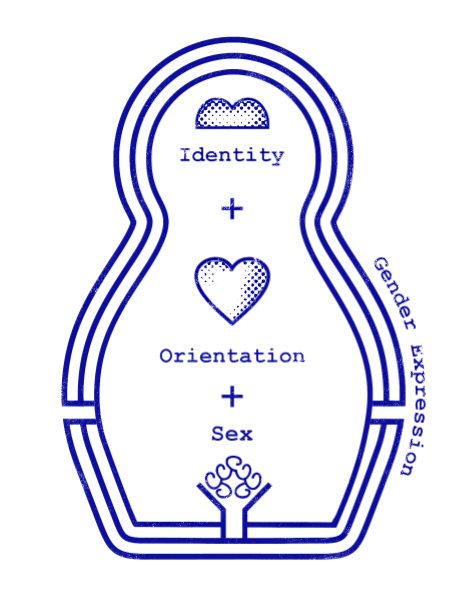
Field: SexualityWe define Sexual Identity as the set of characteristics related to sexuality that is part, along with other identities, of a person’s identity. In this way, a person can identify as North American, Hawaiian, Transgender, Buddhist, Democrat, and Lakers follower.

The atomic model helps us to explain people’s sexuality. Notice that each of the parts has different types, represented by different shades of the same color.
Photo by Moscas de Colores, using mockup de Graficsfuel
For sure, you can find this concept as a synonym for Gender Identity, and this is more frequent the further back you go in time. However, Gender Identity is only one of the five components of Sexual Identity, so its use is not interchangeable. The rest of the components are Biological Sex, Sexual Orientation, Gender Expression, and Sexual Behavior.
Read also: Sexual Identity (Post of our blog. Spanish).
Sexual orientation
Field: Sexual IdentityDefinition
Sexual orientation is the type of emotional and sexual attraction that a person feels toward other people. It may be directed toward the same gender, another gender, multiple genders, or none.
Explanation
Sexual orientation is part of sexual identity and describes toward whom a person’s attraction is directed. It does not refer to how a person perceives themselves (gender identity), how they express themselves (gender expression), or their biological characteristics (biological sex), but specifically to the direction of their attraction.
This attraction may be emotional, romantic, or sexual, and it is not always experienced or expressed in the same way by everyone.
Types of sexual orientation
Some forms of sexual orientation are:
- Heterosexuality
- Homosexuality
- Bisexuality
- Asexuality
- Pansexuality
These categories help describe reality, but they do not encompass it completely. Sexual orientation can be expressed in diverse ways and does not always fit into rigid labels.
Relationship with other components
Sexual orientation is one of the five components of sexual identity.
It is related to:
- Biological sex → does not determine sexual orientation
- Gender identity → is independent of sexual orientation
- Gender expression → does not indicate sexual orientation
- Sexual behavior → does not always align with sexual orientation
Common misconceptions
Sexual orientation is often confused with other related concepts or understood through oversimplified assumptions about how it develops or is expressed.
Some common misconceptions include:
- Thinking that sexual orientation is determined by biological sex
- Assuming that heterosexuality is the expected orientation
- Associating gender expression with sexual orientation
- Believing that sexual behavior necessarily defines sexual orientation
Distinguishing between these concepts helps foster a better understanding of sexual diversity.
In the sexual identity model
In the sexual identity model, sexual orientation is not defined solely by whom a person is attracted to. It also includes how that attraction is experienced and develops.
Example
Two people with the same sexual orientation may have:
- different gender identities
- different forms of gender expression
- different sexual behaviors
This shows that sexual orientation is only one part of sexual identity.
Conclusion
Sexual orientation describes who a person is attracted to, but it does not by itself define their identity. Understanding it within a broader framework, such as sexual identity, helps avoid confusion and better understand sexual diversity.
Related components of sexual identity
- Previous: Gender expression
- Next: Sexual behavior
Third gender
Field: Gender IdentityIt is a category that belongs to the gender identity, also named third sex. A person of the third gender feels identified neither with the masculine gender, nor with the feminine gender, but with another that is a mixture of both.
Top
Field: Sexual behaviorWhen we are talking about gay sex, the top part in anal intercourse is the man who penetrates the other man’s anus with his penis. Depending on the role chosen for sex, gays define themselves as top, bottom or versatile, being the latter ones those who play both roles. The adopted role can be fixed forever, although it can also change with time and circumstances. It is not very clear what are the determinants of the role that each one acquires, but the different consideration that tops had for a long time regarding the bottoms may have some relation, in this sense during the Roman Empire the homosexual behavior of the men did not suppose any problem as long as the active role was adopted, while the bottom role was rejected both in penetration and fellatio, because it was related to women. It is also true that the fear of pain that may cause penetration can be a barrier to adopt the bottom role, a fact that may explain that versatility increases with age and experience. Anatomically the body of all men is prepared to feel pleasure being penetrated.
Synonyms: Pitcher.
See: Pedicabo ego vos et irrumabo. The Catullus poem.
Transgender
Field: Gender Identity
Transgender flag.
There are people whose their biological sex does not match with their gender identity, the transgender people, these people may start if they want a sex reassignment by a combined process of psychological, chemical and surgery, being in this case, transsexual people, there are also many do not want to do it completely or not at all, and just change their appearance. These people may be the most ones who made visible the sexual diversity, and most assaults and murders have suffered and are suffering. They deserve special recognition, support, and love. The cisgender people are who their biological sex match with their gender identity.
Transition
Field: Gender IdentityThe period during which transgender people starts to live as the gender with which they identify. The transition may include change name, take hormones, undergo surgery in the chest, genitals or plastic surgery, changing legal documents to reflect her gender according to their gender identity.
Transphobia
Field: SocietyFear, hatred or contempt felt towards transgender people. Of all phobias to sexual diversity, transphobia is the worst.
Versatile
Field: Sexual behaviorWhen we are talking about gay sex, versatile is the man who, in anal intercourse, can adopt the top and bottom role, that is, penetrate and be penetrated. The adopted role can be permanent forever, but it can also change over time and circumstances. It is unclear which are the determinants of the role that each one acquires, but it is also true that versatility can increase with age and experience.
Variations: vers.
Visibility
Field: SocietyIn this long fight to eradicate phobia towards sexual diversity, visibility of the LGBT people has been an important strategy. Visibility gives hope to those who may not be visible, visibility sprayed prejudice.
Can you help us with the LGBT Glossary?
You can do it in two ways, sending an email with some words you know, and also, spreading our work on your social networks.
Share it!






Share the joy