
Gay Slang Collection
Mostacero. Gay Dictionary (Peru).
Every culture creates its own archetypes, and Peru has the mostacero: the hypermasculine heterosexual, almost a caricature of manhood, who can have sex with other men without feeling that it seriously threatens his self-image.
For years, we assumed the mostacero was little more than a scatological curiosity of Peruvian slang. Over time, however, we came to realize that it concealed something far more interesting: a small lesson about human diversity.
Sexual orientation, sexual behavior, desire and identity do not always move in parallel. And slang is often much quicker than science at finding names for these apparent contradictions.
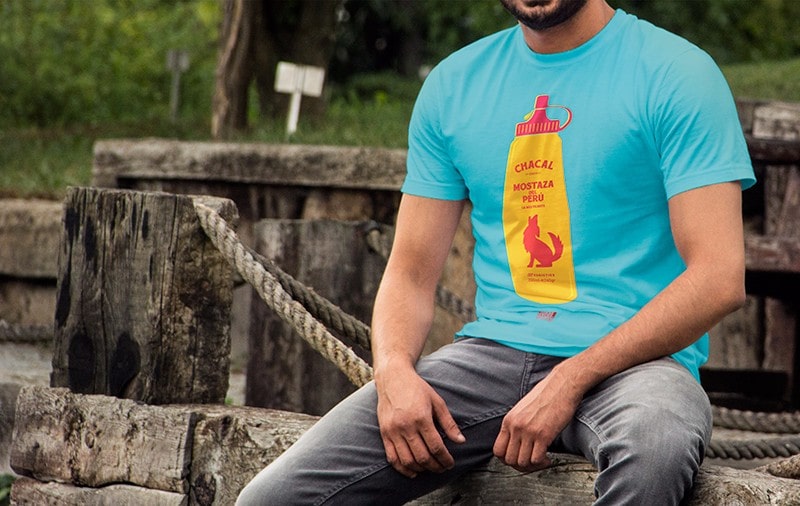
The Mostacero illustration is available printed on T-shirts and a variety of other products.
Since ancient times, .even in societies where homosexual behavior was relatively accepted or tolerated, the man who penetrated (the active partner) was not always regarded in the same way as the man who was penetrated (the passive partner). In many cultures, including ancient Rome, what mattered was not so much who you had sex with, but the role you played during the act. Provided, of course, that in every other aspect of life you behaved as a man was expected to behave in that society.
This unequal valuation of sexual roles, which survives to this day, has allowed some men to indulge certain desires, curiosities or circumstances without feeling that doing so necessarily called their heterosexual identity into question. The mostacero embodies precisely this old macho myth: the need to project a masculinity beyond all doubt. The further he strays from the masculine ideal in certain situations, the more compelled he feels to reaffirm it in every other aspect of his life.
One can never be macho enough.
In Spain, there is an old saying for this kind of man, known as the Ley de Mahoma: tan maricón es el que da como el que toma (“the one who gives it is just as much of a faggot as the one who takes it”). The very existence of the saying suggests that this way of justifying oneself—by claiming to have been the active partner—goes back a long way. Popular wisdom could hardly have been more blunt: the man who penetrated was just as much a maricón as the man who was penetrated.
But the saying carried an additional sting. By invoking Muhammad, it projected the vice onto someone else. After all, it is easier to attribute to others what a society prefers not to acknowledge within itself.
The fags are always someone else.
The Origin of the Mostacero
The original meaning of the word is quite innocent: a mostacero is simply a mustard pot or dispenser. Popular wit, however, has an extraordinary ability to turn the most ordinary household objects into anthropological categories.
The image of mustard dripping from the spout of the container invites an inevitable scatological leap. Let’s not beat around the bush: we’re talking about shit, feces, poop—or whatever you prefer to call it. A mostacero‘s penis, stained with “mustard” after anal intercourse, reveals the term’s ultimate meaning.
We do not know for certain where the expression originated. As with much of the slang surrounding sexuality, it is difficult to tell whether it emerged in gay circles, popular speech or more marginal environments. What we do know is that it eventually came to define a very specific character in the Latin American masculine imagination.
The mostacero is the quintessential macho: the soldier, the sailor, the bricklayer, the truck driver, the muscular guy from the neighborhood, the rugged farmhand, the manual laborer or the conventional heterosexual who, given the opportunity, gets turned on by a young man’s ass.
As is often the case with slang, the meaning is not fixed. Mostacero is also used to refer to men who practice anal sex with women, as well as heterosexual men who, without being particularly macho, occasionally take the active role in sex with other men.
The Desired Macho
But the mostacero says as much about the object of desire as it does about the person who desires it. The mostacero enjoys enormous popularity in the Latin American gay erotic imagination—if not throughout the world. For decades, much of gay culture built an entire mythology around the mostacero.
There is little else to explain. Everyone is attracted to what they are attracted to. Some people fantasize about singers, actors or football players; others have spent decades dreaming about welders, farmers, sailors and bricklayers with girlfriends.
And like every good fantasy, the mostacero comes with its own instructions for use.
The more masculine the mostacero appears, the more desirable he becomes. And the more feminine the gay man, the greater his chances of attracting the attention of the desired macho. What can come from this mutually reinforcing duo? A fair number of dramas, quite a few comedies, and more than one disappointment the morning after.
The Macho After Hours
The mostacero is not unique to the Peruvian imagination. Under one name or another, he can be found in bars all over the world, especially when the night grows long, initial expectations have gone unmet, and the heterosexual market begins to dry up.
He is probably an exaggerated character, created somewhere between desire, humor and observation. But exaggerations are usually rooted in something recognizable.
Perhaps that is why the mostacero continues to hold such appeal. He mischievously suggests that, for some people, heterosexuality depends on the time of day. Some identities seem far more solid at ten o’clock in the evening than they do at four in the morning.
Of Chacales, Mayates and Cucarrones
Elsewhere in Latin America, there are other figures closely related to the mostacero, such as the chacal, chacalote, mayate and cucarrón.
The chacal originally referred to a rugged, working-class, hypermasculine man—the Mexican equivalent of the mostacero. The chacalote was an even more exaggerated version of the same character, sometimes associated with male prostitution, neighborhood delinquents and marginalized young men, all of whom became objects of erotic fascination.
As is often the case with slang, meanings evolve. Today, chacal and chacalote are often used to describe any attractive, masculine or macho-looking guy, regardless of his sexual orientation. A quick look at almost any porn website is enough to see that the contemporary chacal can be virtually any young man with a working-class aesthetic and a decent set of abs.
The mostacero is Peruvian, the chacal is Mexican, yet both seem to belong to the same zoological species: the eternally desired macho.
Mayate, a term used in Mexico, takes its name from a beetle associated with excrement, much like the Colombian cucarrón. Nor is it likely to be a coincidence that the chacal is a scavenger, an opportunistic animal—rather like the mostacero in the early hours of Saturday or Sunday morning. After all, popular imagination has always drawn on the animal world to build its metaphors.
All of these figures seem to share the same intuition: that human beings are far more complex, more adaptable and less predictable than the labels we use to classify them.
The Unbearable Creativity of Being
Perhaps the mostacero‘s greatest lesson lies elsewhere. Sexual diversity is not simply a matter of multiple identities, but of the extraordinary flexibility with which people shape their desires, behaviors and ways of being in the world. A boundless and exasperating creativity for those who insist on reducing everything to neat, binary categories.
That is why the mostacero is about much more than a Peruvian archetype. He represents what happens every time we try to confine human diversity within a label. Categories are useful. People, however, invariably prove to be far more creative than any label.
And thankfully so.
If you're interested in words such as mostacero, explore our Spanish Gay Dictionary and discover many more stories from homosexual slang.

Read also:
Homosexual Behavior and Homosexuality
When you purchase a Moscas de Colores design you not only help us to support this website and this project, but you also become part of the group of people that spread the words, their history and the reality that has gone with us and that still goes with us, because each of our designs is a story that you will tell and explain, an opportunity to help things get better by normalizing, visibilizing and, why not, reappropriating.

Mostacero. Gay Dictionary (Peru).
Mostacero, in addition to mustard pot, is a slang for the homosexual man that has its origin in Peru. This eschatological expression, which shows us that homosexual behavior is very widespread among heterosexual men, we have turned it into an original gay shirt, very funny and very, very spicy.
Other Drawings & Stories of this collection:






Do you like this Drawing & Story?
Tell us what you think about the illustration and what we tell on it. If you like it, you can purchase it printed on t-shirts and different products, to wear them with pride every day or to give to someone special for you.
Share it in your networks!