Moscas de colores

Not Just another Gay site

Menu movil superior EN ES

☰

X

  • THE PROJECT
    • Web
    • Blog
    • Shop

  • DESIGN COLLECTIONS
    • Gay Slang
    • Lesbian Slang
    • Protest!
    • Funny

  • DICTIONARIES
    • Gay Dictionary
    • Lesbian Dictionary
    • LGBT Glossary

Menu desktop superior+buscador EN ES

Mdc
MOSCAS DE COLORES
  • Home
  • Sexual Identity
  • Shop
  • Blog
  • Contact
  • FAQ

Menu movil inferior Diccionario Lesbico EN (nuevo)

Select language
X
  • Arabic
  • Bulgarian
  • Chinese
  • Danish
  • Dutch
  • English
  • Estonian
  • Finnish
  • French
  • German
  • Greek
  • Hebrew
  • Italian
  • Japanese
  • Kalaallisut
  • Korean
  • Norwegian
  • Polish
  • Portuguese
  • Russian
  • Serbian
  • Spanish
  • Tagalog
  • Turkish
  • Valencian
  • Vietnamese
  • Welsh

Menu movil inferior Diccionario Gay EN (nuevo)

Select language
X
  • Afrikaans
  • Albanian
  • Arabic
  • Armenian
  • Azeri
  • Belarusian
  • Bengali
  • Berber / tamazight
  • Bosnian
  • Bulgarian
  • Burmese
  • Chinese
  • Croatian
  • Czech
  • Danish
  • Dutch
  • English
  • Esperanto
  • Estonian
  • Euskera / Basque
  • Farsi-Dari
  • Finnish
  • Flemish
  • French
  • Galician
  • Georgian
  • German
  • Greek
  • Haitian
  • Hawaiian
  • Hebrew
  • Hungarian
  • Irish
  • Italian
  • Japanese
  • Kalaallisut
  • Korean
  • Latvian
  • Lithuanian
  • Luxembourgish
  • Macedonian
  • Malay
  • Norwegian
  • Persian
  • Polish
  • Portuguese
  • Romanian
  • Russian
  • Serbian
  • Sinhala
  • Slovak
  • Slovenian
  • Somali
  • Spanish
  • Sranan Tongo
  • Swahili
  • Swedish
  • Tagalog
  • Thai
  • Tongan
  • Turkish
  • Urdu
  • Valencian
  • Vietnamese
  • Visayan
  • Welsh
  • Yiddish
  • Zulu / Isizulu

Texto con fecha bajo logo

LGBT Universe,
20/Apr/2026
  • Español
  • English

Sexual Identity

Scheme of the components of sexual identity, represented as if it were an atom. Drawn in chalk on a blackboard.

This model explains sexual identity as a system of interrelated components, using an analogy with physics. Each component can take different forms, represented through variations of the same color. This model can be visualized in the following diagram.

Illustration by Moscas de Colores, based on a mockup by Graficsfuel

What is sexual identity?

Sexual identity is the set of characteristics related to a person’s sexuality. These characteristics interact with one another and form part of a person’s overall identity, alongside other aspects such as culture, beliefs, or personality.

Understanding sexual identity helps make sense of human diversity and reduces the confusion often caused by the way these terms are used today.

The problem: confusion around sexual diversity

For a long time, sexual reality was reduced to simple and exclusive categories. However, increased knowledge and visibility have led to the emergence of a wide range of terms, labels, and definitions.

While this has helped recognize diverse realities, it has also created confusion. Different concepts are often mixed or used incorrectly, making them harder to understand.

This is why it becomes necessary to classify, organize, and relate these concepts.

A proposal: sexual identity as a system

To better understand sexual diversity, we propose a model based on the classification and relationship between its components.

This approach does not create new realities, but organizes existing ones in a way that makes them easier to understand.

This model can be visualized in the following diagram.
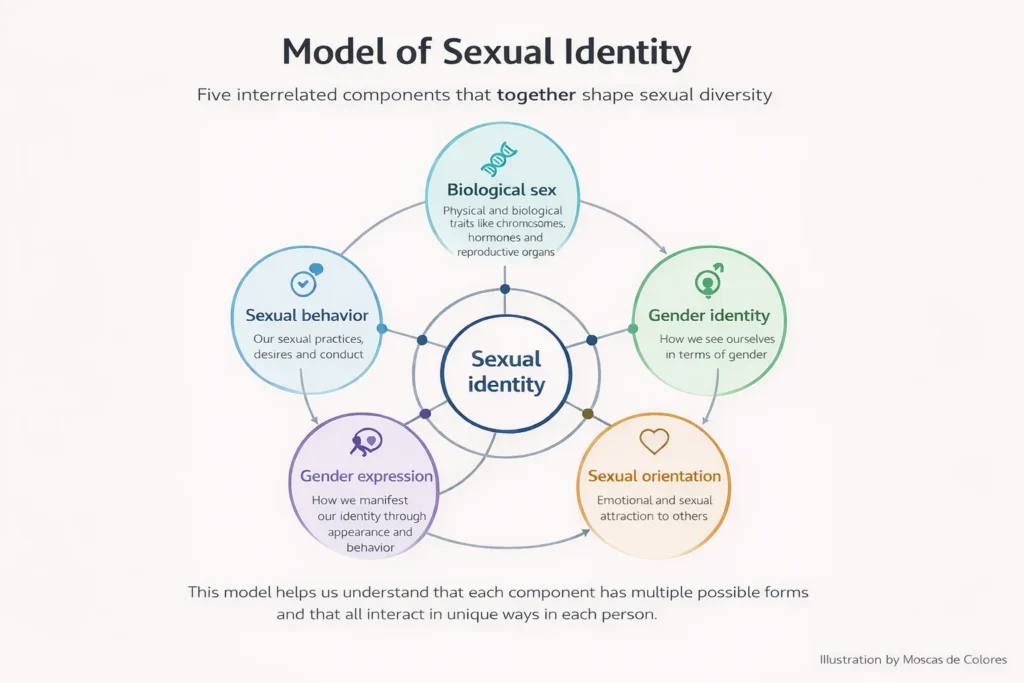
The 5 components of sexual identity

Sexual identity is made up of five main components. Although they are related, each one defines a different aspect.

1. Biological sex

This refers to the physical and biological characteristics of a person, such as chromosomes, hormones, and reproductive organs.

Based on these characteristics, individuals may be classified as male, female, or intersex.

2. Gender identity

This is how a person perceives themselves in relation to gender.

A person may identify as a man, a woman, both, neither, or somewhere along a spectrum.

3. Sexual orientation

This refers to emotional and sexual attraction toward other people.

It may be directed toward the same gender, a different gender, multiple genders, or none.

4. Gender expression

This is how a person expresses their identity through appearance, behavior, or ways of presenting themselves.

It includes aspects such as aesthetics, mannerisms, and social roles.

5. Sexual behavior

This refers to a person’s sexual practices, desires, and behaviors.

It includes both actions and fantasies.

The relationship between components

These five elements do not function in isolation. They interact with one another, giving rise to a wide range of human experiences.

Everyone has these components, although they are expressed differently in each individual.

Rather than creating rigid categories, it is more useful to understand how these elements relate to each other.

Why classification matters

Classifying does not limit reality — it makes it understandable.

When concepts are mixed, discussion becomes confusing and communication breaks down. By contrast, a clear and shared language allows for better understanding, dialogue, and progress.

Using a common, clear framework helps to:

· better understand reality
· avoid confusion
· improve social debate
· support education and policymaking

A tool for understanding, not imposing

This model does not aim to impose a single vision, but to offer a tool for understanding sexual diversity in a clearer and more structured way.

All people share the same components, but each individual combines them in a unique way.

Conclusion

Sexual diversity is not a collection of disconnected labels, but a complex reality that can be better understood when it is organized and analyzed.

Sexual identity is one way of making sense of that reality.

Explore the concepts in detail

If you want to go deeper into each of these components, you can explore our glossary:

👉 Go to the LGBT glossary

Share the joy

Blog EN

Blog

Latest published articles
Check out our blog, a space of information, opinion, and debate on such controversial as the issue of sexual diversity. With these posts, we want to share our point of view on sexuality, an integrating point of view based on science and common sense.
  • g0y, not gay

    Pabupop – 01/10/2019

    Some suggest that the g0y phenomenon arose in the groups of skaters and surfers. Photo: Bromance, by Todd F Niemand, used with CC BY-NC 2.0 / resized and optimized. Some years ago I read an article explaining briefly what g0y men were. Even though I thought homoerotic relationships between heterosexual… Read more
  • How many people are gay? LGBT statistics.

    toni – 01/05/2019

    How many people are gay in the photo? one, two, three? none? Photo: Brighton Pride Party – Bookmaker by Dominic Alves used under CC BY 2.0 / resized and optimized. How many people are gay? 1 in 10? The idea that one in ten people is homosexual is perhaps one… Read more
  • Federico García Lorca and his Ode to Walt Whitman

    Pabupop – 17/08/2017

    As we began our peculiar search for words, we soon found these phrases, which we later knew as verses from Federico García Lorca and his Ode to Walt Whitman. “Faeries of North America, Pájaros of Havana, Jotos of Mexico, Sarasas of Cadiz, Apios of Seville, Cancos of Madrid, Floras of… Read more

Visit our blog

Texto pie de pagina EN ES

WORLDPRIDE 2025 | The Fabric of Freedom

Contenidos Footer EN ES

△

Mdc
MOSCAS DE COLORES
Contact · About us · FAQ · Cookies policy


  • THE PROJECT
    • Web
    • Blog
    • Shop


  • DESIGN COLLECTIONS
    • Gay Slang
    • Lesbian Slang
    • Protest!
    • Funny


  • DICTIONARIES
    • Gay Dictionary
    • Lesbian Dictionary
    • LGBT Glossary

Copyright © 2012–2026 @moscasdecolores · See you soon!
Gestionar consentimiento
Para ofrecer las mejores experiencias, utilizamos tecnologías como las cookies para almacenar y/o acceder a la información del dispositivo. El consentimiento de estas tecnologías nos permitirá procesar datos como el comportamiento de navegación o las identificaciones únicas en este sitio. No consentir o retirar el consentimiento, puede afectar negativamente a ciertas características y funciones.
Funcional Always active
El almacenamiento o acceso técnico es estrictamente necesario para el propósito legítimo de permitir el uso de un servicio específico explícitamente solicitado por el abonado o usuario, o con el único propósito de llevar a cabo la transmisión de una comunicación a través de una red de comunicaciones electrónicas.
Preferencias
El almacenamiento o acceso técnico es necesario para la finalidad legítima de almacenar preferencias no solicitadas por el abonado o usuario.
Estadísticas
El almacenamiento o acceso técnico que es utilizado exclusivamente con fines estadísticos. El almacenamiento o acceso técnico que se utiliza exclusivamente con fines estadísticos anónimos. Sin un requerimiento, el cumplimiento voluntario por parte de tu proveedor de servicios de Internet, o los registros adicionales de un tercero, la información almacenada o recuperada sólo para este propósito no se puede utilizar para identificarte.
Marketing
El almacenamiento o acceso técnico es necesario para crear perfiles de usuario para enviar publicidad, o para rastrear al usuario en una web o en varias web con fines de marketing similares.
  • Manage options
  • Manage services
  • Manage {vendor_count} vendors
  • Read more about these purposes
Ver preferencias
  • {title}
  • {title}
  • {title}