Moscas de colores

Not Just another Gay site

Menu movil superior EN ES

☰

X

  • THE PROJECT
    • Web
    • Blog
    • Sexual Identity
    • Shop

  • DESIGN COLLECTIONS
    • Gay Slang
    • Lesbian Slang
    • Protest!
    • Funny

  • DICTIONARIES
    • Gay Dictionary
    • Lesbian Dictionary
    • LGBT Glossary

Menu desktop superior+buscador EN ES

Mdc
MOSCAS DE COLORES
  • Home
  • Sexual Identity
  • Shop
  • Blog
  • Contact
  • FAQ

Menu movil inferior Diccionario Lesbico EN (nuevo)

Select language
X
  • Arabic
  • Bulgarian
  • Chinese
  • Danish
  • Dutch
  • English
  • Estonian
  • Finnish
  • French
  • German
  • Greek
  • Hebrew
  • Italian
  • Japanese
  • Kalaallisut
  • Korean
  • Norwegian
  • Polish
  • Portuguese
  • Russian
  • Serbian
  • Spanish
  • Tagalog
  • Turkish
  • Valencian
  • Vietnamese
  • Welsh

Menu movil inferior Diccionario Gay EN (nuevo)

Select language
X
  • Afrikaans
  • Albanian
  • Arabic
  • Armenian
  • Azeri
  • Belarusian
  • Bengali
  • Berber / tamazight
  • Bosnian
  • Bulgarian
  • Burmese
  • Chinese
  • Croatian
  • Czech
  • Danish
  • Dutch
  • English
  • Esperanto
  • Estonian
  • Euskera / Basque
  • Farsi-Dari
  • Finnish
  • Flemish
  • French
  • Galician
  • Georgian
  • German
  • Greek
  • Haitian
  • Hawaiian
  • Hebrew
  • Hungarian
  • Irish
  • Italian
  • Japanese
  • Kalaallisut
  • Korean
  • Latvian
  • Lithuanian
  • Luxembourgish
  • Macedonian
  • Malay
  • Norwegian
  • Persian
  • Polish
  • Portuguese
  • Romanian
  • Russian
  • Serbian
  • Sinhala
  • Slovak
  • Slovenian
  • Somali
  • Spanish
  • Sranan Tongo
  • Swahili
  • Swedish
  • Tagalog
  • Thai
  • Tongan
  • Turkish
  • Urdu
  • Valencian
  • Vietnamese
  • Visayan
  • Welsh
  • Yiddish
  • Zulu / Isizulu

Texto con fecha bajo logo

LGBT Universe,
12/May/2026
  • Español
  • English
BLOG

Sexual Diversity

Sexual Plasticity
Pabupop – 11/05/2026
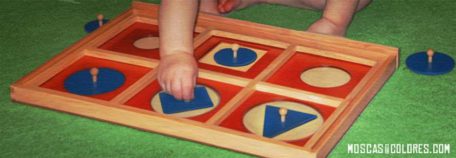
Sexual plasticity. A baby trying to fit pieces into a board without following traditional shapes.

Defining our sexual identity can involve an imperfect fit. The concept of sexual plasticity helps explain why human sexual identity does not always fit perfectly within traditional sexual categories.

Constructed, adaptable and changing sexuality

For a long time, people believed that a person’s sexuality was fixed, predetermined and immutable: a sort of internal essence that accompanied an individual throughout life with little or no change. According to this traditional view, a person was born heterosexual or homosexual, male or female, and these characteristics remained stable forever.

However, human reality is far more complex.

Human sexual diversity, as well as the changes that the components of sexual identity may undergo throughout life, show that human sexuality possesses a significant degree of plasticity. Sexuality is not a rigid block, but a dynamic system influenced by biology, environment, culture, experience, social relationships and adaptive needs.

The usual way of categorizing people, useful in certain contexts and periods, fails when we try to explain the full diversity of human sexuality. Many people do not fit completely within traditional categories and display experiences, behaviors and identities that are far more complex and fluid.

It is impossible to fully understand human reality without partially moving beyond the traditional male-female framework and its derivatives, especially at a historical moment in which traditional categories are insufficient to describe human diversity.

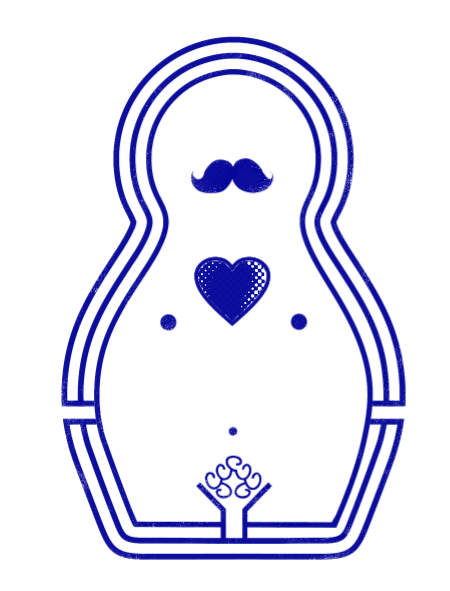
Khing illustration for the Gay Slang Series.

Khing illustration for the Gay Slang Series.

Sexual identity and its components

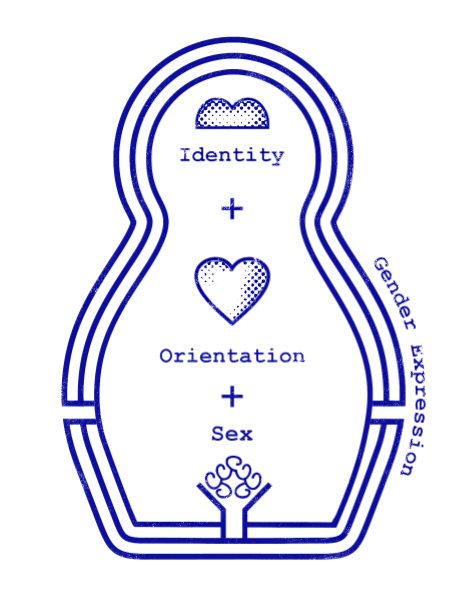
Sexual identity is not made up of a single element, but of different interconnected components:

  • biological sex,
  • sexual orientation,
  • gender identity,
  • gender expression,
  • and sexual behavior.

Traditionally, many societies have treated these components as if they were permanent and perfectly aligned with one another. Yet human experience shows that this is not always the case.

The components of sexual identity can change, reorganize or evolve over time. Some people modify their gender expression; others experience changes in their sexual behavior, emotional bonds or the way they define themselves. Even certain aspects of biological sex can be altered through hormonal treatments or medical interventions.

This does not mean that sexual identity is simply a voluntary choice or that everything can change without limits. Sexual plasticity does not imply the absence of structure, but rather the capacity for adaptation and variation within certain biological, psychological and social boundaries.

Just as the human brain possesses neural plasticity and changes through experience and environment, human sexuality also seems to possess a significant capacity for transformation and adaptation.

Sexuality, culture and adaptation
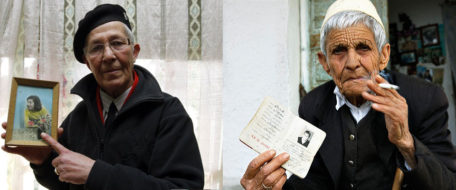
Two photographs of Albanian sworn virgins.

Albanian sworn virgins, an example of sexual plasticity.

Human sexual diversity cannot be fully understood without taking cultural and social context into account.

Many societies have developed mechanisms to integrate, regulate or reinterpret people who did not easily fit within traditional categories of men and women.

In Tonga, for example, many socially visible homosexual men are not understood simply as “gay men,” but are culturally pushed toward the category of fakaleitī, a traditional transgender identity. Likewise, in Albania there were the so-called sworn virgins, women who adopted a male social role, especially when the men in the family died in war or disappeared and it became necessary to assume their social functions within a deeply patriarchal society. In Mexico, muxes have constituted a socially recognized gender identity for centuries.

There are also situations in which social circumstances profoundly modify people’s sexual behavior. The increase in homosexual behavior in prisons, boarding schools or contexts where heterosexual relationships are very difficult or impossible is one of the best-known examples.

In other cases, social pressure attempts to force the different components of sexual identity to fit within dominant cultural norms. For years, for example, some homosexual men in Iran were pressured into sex reassignment as a way of forcing their reality to fit within a strictly heterosexual model.

All these examples show that human sexual identity is neither completely rigid nor universal, but constantly interacts with social and cultural environments.

Societies do not only repress certain forms of sexuality; they also create new categories, possibilities and identities.

Sexual plasticity

Colored modeling clay representing sexual plasticity.

The concept of sexual plasticity helps us understand sexual diversity.

Sexual plasticity is neither an error nor an anomaly, but a characteristic of a highly social, adaptable and cultural species such as humanity, and possibly an important evolutionary advantage.

Sexuality does not serve reproduction alone. It also fulfills social, emotional and relational functions: it strengthens bonds, reduces tension, promotes cooperation, generates group cohesion and helps organize social relationships.

Bonobos are one of the best-known examples. These primates frequently use sexual behavior — including homosexual behavior — to resolve conflicts, reduce aggression and reinforce group cohesion.

Sexuality can therefore function as a social tool in addition to a reproductive one.

In other animal species there are also multiple forms of sexual plasticity: sex changes in fish and mollusks, functional reorganization in social insects, homosexual behavior, adoption or non-reproductive bonds.

All of this is possible because of sexual plasticity.

From this perspective, human sexual diversity no longer appears to be a strange exception, but rather a logical consequence of a deeply social, cultural and adaptable species.

Sexual categories and human complexity

Concepts such as “heterosexual,” “homosexual,” “man,” “woman,” “masculine” or “feminine” remain useful for social orientation and for describing many human experiences. The problem arises when these categories are considered absolute, rigid or capable of describing the full complexity of human sexuality.

Reality shows much more diffuse boundaries: people who change over time, behaviors that vary depending on context, multiple identities, non-exclusive orientations, variable gender expressions or experiences that do not completely fit within any traditional category.

Sexual categories are useful cultural tools, but they are not reality itself.

Conclusion

Sexual plasticity does not mean that sexuality is false, arbitrary or infinitely modifiable. It means that human sexual identity possesses a significant capacity for adaptation, transformation and diversity.

Human sexuality probably did not evolve to be completely rigid, but rather to respond flexibly to different biological, social and cultural contexts.

Sexual diversity has been part of the human species since its origins and also appears constantly in numerous animal species.

Perhaps the real problem has never been sexual diversity itself, but rather the difficulty some cultural models have in accepting and understanding the complexity of human nature.
Related reading

  • Sexual Fluidity in Males and Females, Lisa M. Diamond.
  • Bonobo Sex and Society, Frans de Waal.
Tag :Compared Sexuality, Nature, Sex, Sexual Plasticity

Something to say?

Tell us what you think of this article. If it’s good or bad, if you think we are idiots, or if you see us in hell. Even if you are a few words person, to improve people’s lives, help us spread it.

Share it in your networks!

And leave us a comment
▼ Be the first to comment
▲ Close coments

Leave a Reply Cancel reply

Your email address will not be published. Required fields are marked *

Share the joy

Columna Diccionarios-Blog + Menus series-diccionarios EN

Everything we post on this blog is opinion articles, but we've classified them into these categories to highlight the relevant topic. What interests you the most?
  • Opinions
  • Sexual Diversity
  • LGBT History
  • Queer Words
  • Inside Moscas de Colores
42 original and fun designs to buy printed on t-shirts and other items. Claim each day or treat someone special with one of our Drawings & Histories. Which one do you like the most?
  • Funny Collection
  • Lesbian Slang Collection
  • Protest! Collection
  • Gay Slang Collection
More than 2,200 entries in 68 languages make up the largest LGBT + dictionary on the web, with a glossary of sexuality terms explained for you to understand. Do not leave with doubt!
  • Gay Dictionary
  • Lesbian Dictionary
  • LGBT Glossary
Tiefseeforscherin. Lesbian Dictionary (Germany). Le Patate Lepakko. Lesbian Dictionary (Finland). Tomboy. Lesbian Dictionary (United Kindom).

Diccionarios EN

The biggest LGBT Dictionary on the net.
12/May/2026

The words are the heart of our project, they discover the stories to us and with them, we create the designs. Just words.

Gay Dictionary

How to say Gay
Counting with more than 1700 words and expressions from 68 languages. Learn how to say gay in Spanish, English, or Swahili, and what words teach us on sexual diversity.

Lesbian Dictionary

How to say Lesbian
Counting with more than 500 words and expressions from 27 languages. Learn how to say lesbian in Spanish or Italian, and where does the machismo of today come from.

LGBT Glossary

Definitions of reality
Sex, gender identity, gender expression, and sexual orientation are the main categories with which to start a great journey whose destiny is yourself.

Blog EN

Blog

Latest published articles
Check out our blog, a space of information, opinion, and debate on such controversial as the issue of sexual diversity. With these posts, we want to share our point of view on sexuality, an integrating point of view based on science and common sense.
  • g0y, not gay

    Pabupop – 01/10/2019

    Some suggest that the g0y phenomenon arose in the groups of skaters and surfers. Photo: Bromance, by Todd F Niemand, used with CC BY-NC 2.0 / resized and optimized. Some years ago I read an article explaining briefly what g0y men were. Even though I thought homoerotic relationships between heterosexual… Read more
  • How many people are gay? LGBT statistics.

    toni – 01/05/2019

    How many people are gay in the photo? one, two, three? none? Photo: Brighton Pride Party – Bookmaker by Dominic Alves used under CC BY 2.0 / resized and optimized. How many people are gay? 1 in 10? The idea that one in ten people is homosexual is perhaps one… Read more
  • Federico García Lorca and his Ode to Walt Whitman

    Pabupop – 17/08/2017

    As we began our peculiar search for words, we soon found these phrases, which we later knew as verses from Federico García Lorca and his Ode to Walt Whitman. “Faeries of North America, Pájaros of Havana, Jotos of Mexico, Sarasas of Cadiz, Apios of Seville, Cancos of Madrid, Floras of… Read more

Visit our blog

Texto pie de pagina EN ES

WORLDPRIDE 2025 | The Fabric of Freedom

Contenidos Footer EN ES

△

Mdc
MOSCAS DE COLORES
Contact · About us · FAQ · Cookies policy


  • THE PROJECT
    • Web
    • Blog
    • Sexual Identity
    • Shop


  • DESIGN COLLECTIONS
    • Gay Slang
    • Lesbian Slang
    • Protest!
    • Funny


  • DICTIONARIES
    • Gay Dictionary
    • Lesbian Dictionary
    • LGBT Glossary

Copyright © 2012–2026 @moscasdecolores · See you soon!
Gestionar consentimiento
Para ofrecer las mejores experiencias, utilizamos tecnologías como las cookies para almacenar y/o acceder a la información del dispositivo. El consentimiento de estas tecnologías nos permitirá procesar datos como el comportamiento de navegación o las identificaciones únicas en este sitio. No consentir o retirar el consentimiento, puede afectar negativamente a ciertas características y funciones.
Funcional Always active
El almacenamiento o acceso técnico es estrictamente necesario para el propósito legítimo de permitir el uso de un servicio específico explícitamente solicitado por el abonado o usuario, o con el único propósito de llevar a cabo la transmisión de una comunicación a través de una red de comunicaciones electrónicas.
Preferencias
El almacenamiento o acceso técnico es necesario para la finalidad legítima de almacenar preferencias no solicitadas por el abonado o usuario.
Estadísticas
El almacenamiento o acceso técnico que es utilizado exclusivamente con fines estadísticos. El almacenamiento o acceso técnico que se utiliza exclusivamente con fines estadísticos anónimos. Sin un requerimiento, el cumplimiento voluntario por parte de tu proveedor de servicios de Internet, o los registros adicionales de un tercero, la información almacenada o recuperada sólo para este propósito no se puede utilizar para identificarte.
Marketing
El almacenamiento o acceso técnico es necesario para crear perfiles de usuario para enviar publicidad, o para rastrear al usuario en una web o en varias web con fines de marketing similares.
  • Manage options
  • Manage services
  • Manage {vendor_count} vendors
  • Read more about these purposes
Ver preferencias
  • {title}
  • {title}
  • {title}