
Gay Slang Collection
Palomo Cojo. Gay Dictionary (Spain).
What Is the Origin of the Spanish Expression “Palomo Cojo”?
Palomo Cojo (“Lame Pigeon”) is, together with tortillera, one of the most searched entries in our Spanish Gay Dictionary. It became the title of a novel and its film adaptation, and continues to appear frequently in the media, on social networks, and in everyday speech. But where does this expression really come from? Did it originate in competitive pigeon breeding (columbiculture), as is often claimed, or is there a more convincing explanation?
In this article, we trace the history of the word palomo (“male pigeon”), examine the metaphorical meaning of cojo (“lame”), and review the main theories about the origin of the expression in an attempt to reconstruct its history based on the available historical evidence.

Palomo Cojo illustration, available on T-shirts and many other products.
The Palomo as a Metaphor for the Lover
Everyone knows what a pigeon is. What few people realize is that, for centuries, the palomo ceased to be merely a bird and became a metaphor for the man in love, the suitor, the gallant and, ultimately, the masculine figure whose cultural identity was closely associated with courting women. Without understanding that evolution, it is difficult to grasp the true origin of the expression Palomo Cojo.
The explanation goes back much further than Spanish literature. Since Antiquity, the dove has been one of the great Mediterranean symbols of love and fidelity. In the Greek world, it became closely associated with Aphrodite, the goddess of love, and that symbolism was later inherited by Roman tradition.
Nor was this association accidental. Unlike many other birds, pigeons form stable pairs and display a particularly striking courtship ritual. The male puffs out his chest, fans his tail, circles the female while cooing persistently, and follows her for a long time until he succeeds in attracting her attention. This image of the male devoted entirely to courting the female made the bird an almost perfect metaphor for the lover.
The earliest surviving texts in Spanish already point in this direction. In the Sendebar, a collection of tales translated into medieval Castilian around 1253, a pair of pigeons represents marriage and marital fidelity. At this stage, the symbol did not yet refer to a specific man, but rather to the loving union itself.
Over the following centuries, the meaning gradually shifted. The palomo ceased to represent the couple and came to identify the man in love directly. By the sixteenth century, Fray Luis de León employed the image in his translation of the Song of Songs, and Luis de Góngora could write the famous words «nací para palomo» (“I was born to be a palomo”). During the seventeenth century, the expression became even more common, and numerous examples can be found in which palomo simply means a gallant, a suitor or a man in love.
The evolution continued over the following centuries. What had begun as a literary image eventually entered everyday language. In 1788, Esteban de Terreros included the following brief yet revealing definition in his Diccionario castellano:
“Palomo. A common term for a lustful man.”
Beyond the moral vocabulary typical of eighteenth-century lexicography, the definition confirms an important fact: palomo had ceased to be merely a poetic metaphor and had become a popular way of referring to a man especially inclined to court women.
That figurative meaning survived throughout the nineteenth and twentieth centuries. Writers such as José María de Pereda, Federico García Lorca and Pepe Monagas continued to use palomo to refer to the gallant, the womanizer or the man in love. The symbol remained alive because it continued to evoke the same image: a man whose role was to pursue, court and win over women.
For more than five centuries, the palomo ceased to be merely a bird and became a recognizable figure in popular culture. First, it symbolized love; later, the lover; then the suitor and the gallant; and finally, the man identified with courting women. This long evolution explains why, when someone first called a man Palomo Cojo, there was no need to explain what a palomo was. The symbol had already been part of the collective imagination for centuries. The strength of the expression did not lie in the noun, whose meaning everyone understood, but in the adjective: cojo (“lame”).
The Figurative Meaning of Cojo
If the meaning of palomo can be reconstructed through its historical evolution, cojo appears, at first glance, to be a much simpler word. What does it actually contribute to the expression? The immediate answer might be that it refers to a bird unable to walk or court normally. However, in Spanish, cojo also has a much broader figurative meaning than that of a physical characteristic.
A table can be said to be coja. We also speak of a cojo argument, a coja explanation, or a coja theory. In all these cases, cojo no longer describes a physical characteristic—a limp—but becomes a metaphor for something that fails to function properly because it lacks something essential.
That figurative meaning holds the key to understanding Palomo Cojo. If the palomo symbolized the man who courted women, the adjective does not necessarily refer to an actual limp. It may simply indicate that the palomo is defective because, in the eyes of society at the time, he was not considered sufficiently masculine.
This phenomenon is not unique to cojo. Spanish frequently uses physical characteristics to construct metaphors. We say that love is blind, that justice is blind, speak of someone lacking tact, or refer to a silent war without implying an actual disability. In the same way, cojo not only describes a physical characteristic but is also applied to anything that lacks an essential element needed to fulfil its function.
Even before studying the history of the expression itself, we can already draw an important conclusion. Cojo does not necessarily describe a physical characteristic of the palomo. Rather, it strips the palomo of the symbolic meaning that language had attached to it and turns it into the caricature of the traditional suitor. It is precisely by bringing that idea together with the palomo’s long symbolic tradition that the expression begins to reveal its true meaning.
How Did Palomo Cojo Come Into Being?
Once we understand the meaning of palomo and the figurative meaning of cojo, the expression begins to explain itself. If, for centuries, the palomo had symbolized men who courted women, then a palomo cojo would, in principle, be a palomo deprived of precisely that which gave the symbol its meaning.
There is, however, another explanation for the origin of the expression that has gained widespread currency.
According to this hypothesis, the expression originated in the world of competitive pigeon sport, a discipline in which several male pigeons compete to win a single female. In this sport, especially vigorous and persistent birds are selected and trained to pursue and win over the hen across long distances. Under this explanation, a palomo cojo, being unable to follow her properly, would eventually be displaced by the other males and, by analogy, the expression would have come to refer to a homosexual man.
At first glance, this hypothesis is attractive. It links the bird’s behaviour to a sport that is popular in many parts of Spain and offers an image that is easy to remember. However, once examined more closely, doubts begin to arise.
The first difficulty is of a historical nature. The metaphor of the palomo applied to a man did not begin in competitive pigeon sport but many centuries earlier. From the Middle Ages and, especially during the Spanish Golden Age, Spanish already used palomo to refer to a lover, a suitor, or a lustful man. By the time the expression palomo cojo appeared, the symbol had already been fully established for centuries and was perfectly understandable without any need to resort to competitive pigeon sport.
The second difficulty comes from competitive pigeon sport itself. If the expression had originated in that world, one would expect the concept of the palomo cojo to be familiar to pigeon fanciers themselves. However, the manuals we have consulted do not seem to point in that direction. The Italian work I colombi (1887), one of the oldest and one of the most comprehensive treatises on competitive pigeon sport that we have been able to consult, discusses diseases, leg injuries, and reproductive problems, but does not present lameness as a relevant circumstance in the pigeon’s sexual or reproductive behaviour. Nor have we found any references to it in the Spanish manuals or in the various specialist publications we consulted. It does not even appear to have been a category of interest to pigeon fanciers. A bird with a serious leg injury was simply no longer useful. The image of the palomo cojo, as it appears in the popular expression, does not seem to form part of that world’s collective imagination. This does not prove that the hypothesis is false, but it does weaken the claim that the expression originated among pigeon fanciers themselves.
If competitive pigeon sport does not provide conclusive evidence about the origin of the expression, it is more useful to turn to historical documentation. The earliest written occurrence we have located so far comes from the novel Días de guardar (1981) by Carlos Pérez Merinero, where one character says: “Your husband is more of a faggot than a palomo cojo.” The expression appears without any explanation, suggesting that the reader was already expected to understand it.
Ten years later, Eduardo Mendicutti would make it the title of his celebrated novel El palomo cojo. The author later explained that he had not coined the expression himself: he had heard it since childhood in Andalusia and Extremadura. His testimony is particularly valuable because it shows that the expression was already circulating orally before it achieved literary circulation. All this suggests that it had existed well before its first known written record, even though no earlier examples have yet been found.
This chronology is also consistent with the rise in popularity of competitive pigeon sport in Spain between the late nineteenth century and the early decades of the twentieth. That context may well have provided a favourable setting for the emergence of the expression or even inspired the person who coined it. However, the available evidence does not require us to locate its origin within that world.
In the light of all the available evidence, it seems more likely that the expression emerged in popular speech from an already well-established metaphor than within the world of competitive pigeon sport itself. The palomo already represented the man whose symbolic function was to court women. In adding the adjective cojo, the language did not need to describe an injured bird. It was enough to deprive the traditional suitor of that which gave the symbol its meaning, turning him into the caricature of a man who, according to traditional attitudes, did not seem to correspond to the ideal of masculinity associated with the symbol of the palomo.
“More of a Faggot Than a Palomo Cojo”
The earliest documented occurrence of the expression is not palomo cojo used independently, but rather the comparison “more of a faggot than a palomo cojo.” This detail poses an interesting question: did palomo cojo already exist as an independent expression, or was it through this very comparison that it entered popular speech?
Like other traditional Spanish comparisons—such as más feo que Picio (“uglier than Picio”), más tonto que Abundio (“stupider than Abundio”), or más lento que el caballo del malo (“slower than the villain’s horse”)—“more of a faggot than a palomo cojo” is not intended to describe reality accurately, but to exaggerate it. Its force lies precisely in the hyperbole itself.
For much of the twentieth century, moreover, male homosexuality remained hidden under social pressure and even legal persecution. In that context, expressions such as “more of a faggot than a palomo cojo” could hardly, in most cases, have been based on certain knowledge of the person concerned’s private life. A way of speaking, gestures regarded as effeminate, behaviour that departed from the traditional ideal of masculinity, or simply rumour, was enough. Rather than stating a fact, the comparison served to ridicule, insinuate, or fuel rumours.
Expressions like this not only reflected the social norms of their time, but also contributed to reinforcing them by ridiculing those who departed from the traditional model of masculinity.
Today, the expression has lost much of the cultural context that gave rise to it. Yet it still preserves the memory of the society that created it. By studying its origin, we do more than reconstruct the history of these words; we also recover the way of thinking of those who uttered them.
Words are fossils. They preserve far more than their meaning: they preserve the way of thinking of the society that created them. For that reason, studying their history is not simply a matter of discovering where words come from, but also of discovering who we were when we invented them.
Explore our Spanish Gay Dictionary to discover more words and their fascinating stories, or visit our blog for fresh perspectives on human sexual diversity and relevant scientific research.
When you purchase a Moscas de Colores design you not only help us to support this website and this project, but you also become part of the group of people that spread the words, their history and the reality that has gone with us and that still goes with us, because each of our designs is a story that you will tell and explain, an opportunity to help things get better by normalizing, visibilizing and, why not, reappropriating.

Palomo Cojo. Gay Dictionary (Spain).
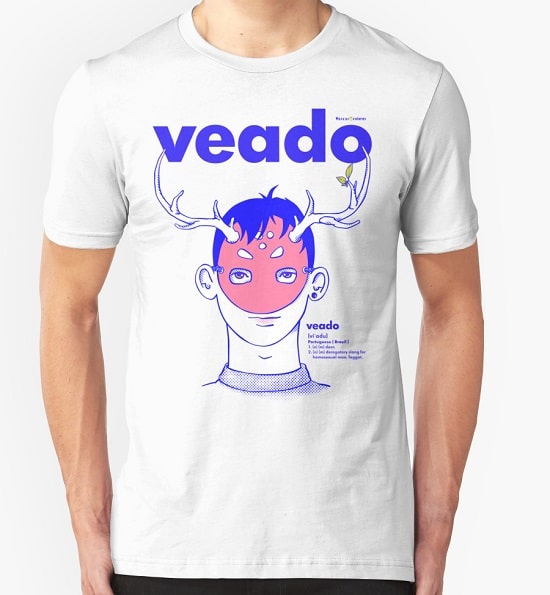
Palomo Cojo is one of the best-known expressions in Spain to name gay people and that we have turned into this nice Drawing & Story, a pigeon, in a collage style, with its little leg put in plaster and its breast full of hearts. Printed on a pink background it is a very gay shirt to wear with proud every day.
Other Drawings & Stories of this collection:






Do you like this Drawing & Story?
Tell us what you think about the illustration and what we tell on it. If you like it, you can purchase it printed on t-shirts and different products, to wear them with pride every day or to give to someone special for you.
Share it in your networks!