
Sexual Diversity
Pupil dilation and sexual orientation
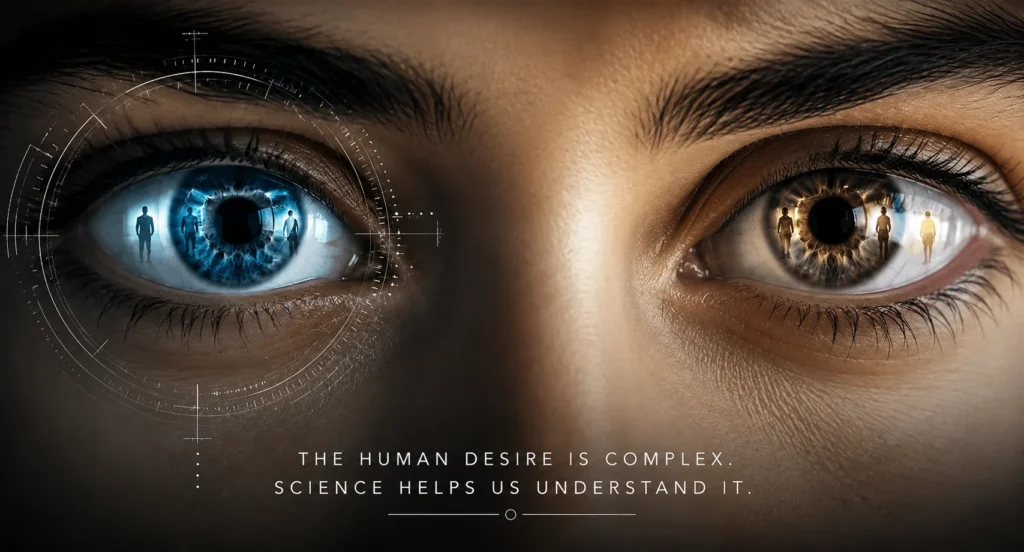
Can Pupil Dilation Reveal a Person’s Sexual Orientation?
Pupils, Desire and a Viral Headline
What if a camera could detect which people sexually arouse you simply by observing your pupils?
For years, an idea as unsettling as it was fascinating circulated online: that analyzing pupil dilation was enough to uncover a person’s sexual orientation. The headline sounded like something out of a science-fiction movie, but behind the claim there was a real scientific study conducted by researchers at Cornell University. And, as often happens, the reality was far more complex—and far more interesting—than the viral headline suggested.
At Moscas de Colores, we have always been particularly interested in research on sexual diversity and the different ways people experience desire, attraction, and identity. So we decided to go directly to the original study to see what it actually said. Could sexual orientation really be detected by looking at someone’s eyes? Was it true that our pupils could betray our most intimate desires? Or were we simply looking at yet another example of scientific sensationalism?
The first thing we discovered was something important: the study was not intended to “detect homosexuals,” as many headlines implied. Its goal was far more ambitious. The researchers were trying to better understand how human sexual arousal works and how physiological responses, self-reported sexual orientation, attraction, and desire relate to one another.
And what they found was particularly interesting because it pointed toward an idea that now occupies a central place in many studies of sexuality:
Human sexuality does not fit easily into rigid categories.
The Background: When Governments Tried to Detect Homosexuality
The idea of using pupils to study sexual arousal was not entirely new. Pupil dilation can function as an involuntary physiological response associated with interest, attention, or sexual arousal. When something attracts, surprises, or stimulates us, our pupils may dilate without any conscious control.
For precisely that reason, between the 1950s and the 1970s, the Canadian government conducted research aimed at detecting homosexual individuals through involuntary physiological responses. During the Cold War, homosexuality was considered a “national security risk,” particularly within military and government environments, and authorities sought methods to identify employees who might be considered suspicious.
That project eventually became known as the Fruit Machine, one of the most disturbing chapters in the history of modern sexology.

Artistic recreation of the Fruit Machine, an experimental program used during the Cold War to detect homosexuality through involuntary physiological responses.
The system attempted to measure involuntary responses—including pupil dilation—when subjects were exposed to erotic images. However, the technology of the time was extremely limited, and the results proved unreliable.
Decades later, technological advances made it possible to revisit this research from a completely different perspective. The goal was no longer to persecute homosexual individuals, but to better understand the complexity of human sexuality.
The Cornell University Study
The study was conducted by Gerulf Rieger and Ritch C. Savin-Williams and published in 2012 under the title The Eyes Have It: Sex and Sexual Orientation Differences in Pupil Dilation Patterns. Its main innovation was the use of an infrared eye-tracking system capable of accurately measuring pupil dilation while participants viewed different erotic stimuli.
Compared with traditional methods of sex research—primarily based on genital measurements—this technique offered a major advantage: it was far less invasive. The researchers noted that studies based on genital responses generated significant biases because not everyone was willing to participate in such experiments. Moreover, they made research in conservative societies and among younger populations considerably more difficult.
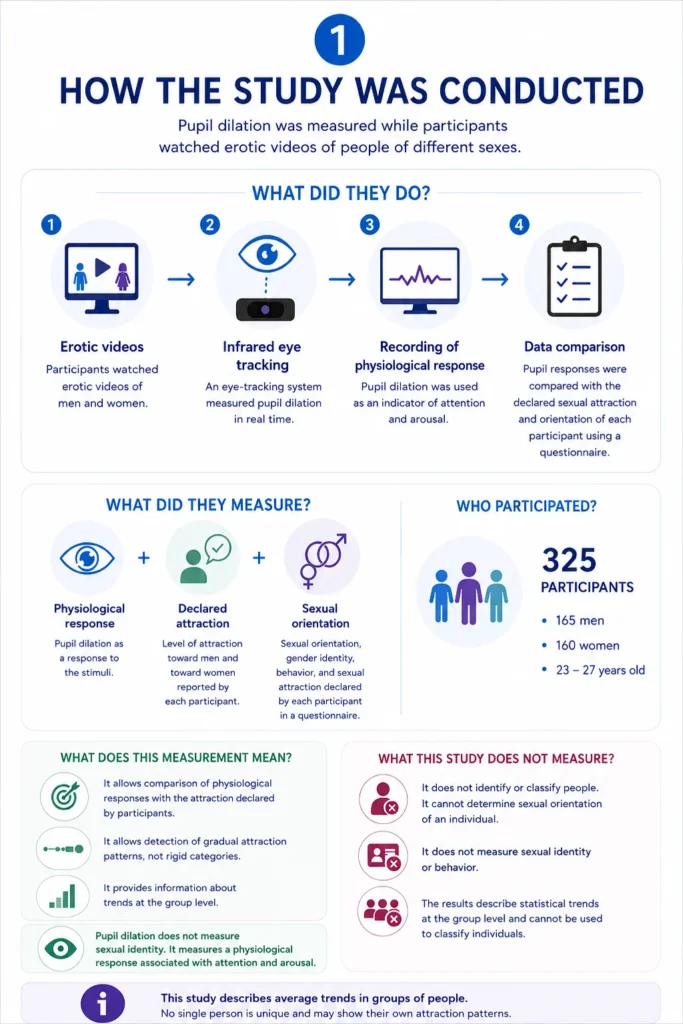
Eye-tracking system used to measure pupil dilation while participants viewed erotic stimuli.
For the experiment, the researchers selected 325 participants between the ages of 23 and 27: 165 men and 160 women. Most were recruited through university advertisements, although some bisexual men were contacted through dating websites where they were seeking relationships with both men and women.
Participants were shown erotic videos featuring men and women masturbating, as well as neutral landscape videos used as a control condition. While they watched the videos, an infrared tracking system continuously measured the dilation of their pupils.
However, the study did not focus solely on automatic reactions. After each video, participants answered questions about:
- how attractive they found the people in the videos,
- whether they considered them sexually arousing,
- whether they would like to go on a date with them,
- and how they defined their own sexual orientation.
In other words, the researchers combined several different elements:
- physiological response,
- subjective attraction,
- sexual desire,
- behavior,
- and self-reported identity.
This is important because the study did not demonstrate that all these dimensions were exactly the same thing. In fact, part of its significance lay in showing that they might not fully coincide.
The researchers used a scale similar to the Kinsey Scale, where 0 represented exclusive heterosexuality and 6 represented exclusive homosexuality. This already suggests something important: for the authors of the study, sexual orientation did not necessarily function as a binary category.
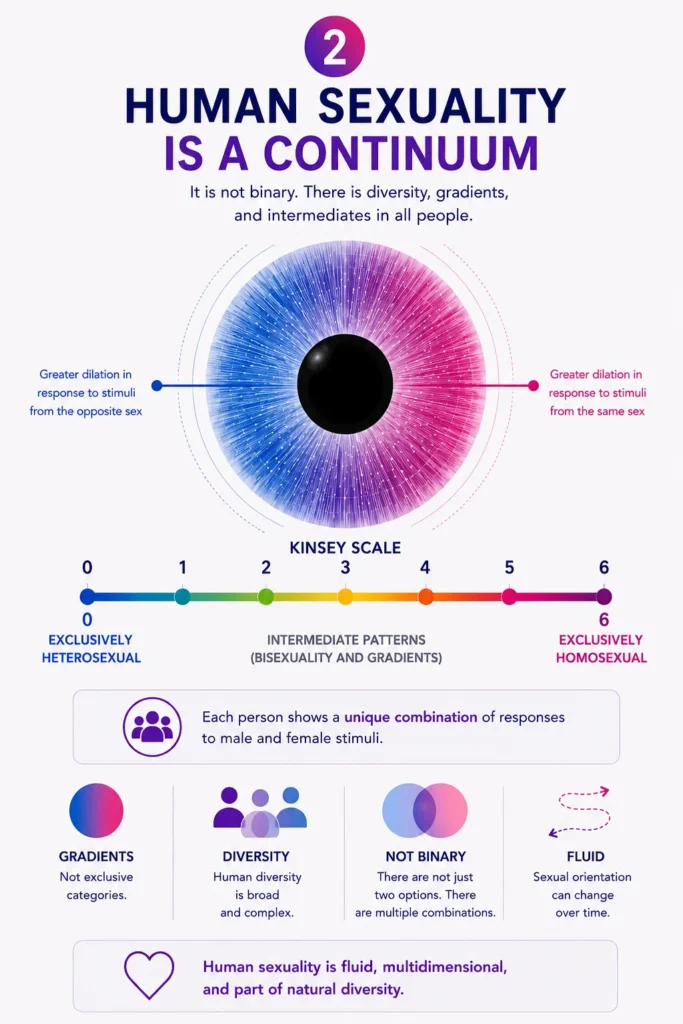
Sexual orientation can be understood as a continuum with multiple intermediate positions.
What Did the Study Actually Discover?
The experiment produced several particularly interesting findings.
First, there was a strong correlation between participants’ self-reported sexual orientation and their physiological responses. In general terms, people displayed patterns of arousal that were consistent with the orientation they reported.
Heterosexual men showed greater pupil dilation in response to female stimuli, whereas homosexual men reacted primarily to male stimuli.
However, the most interesting part of the study emerged when the researchers examined intermediate patterns and differences between men and women.
Male Bisexuality and Intermediate Patterns
One of the most striking findings was that bisexual men showed pupil dilation in response to both male and female stimuli. Furthermore, the researchers found evidence of something particularly interesting: there were “mostly heterosexual” men whose responses differed from those of exclusively heterosexual men.
For a long time, men were assumed to be sexually “rigid”: either heterosexual or homosexual. Intermediate patterns were often interpreted as confusion, transition, or denial. The Cornell study partly challenged this view and suggested that male sexual arousal may be more flexible and gradual than traditionally assumed.
In other words, even categories such as “straight,” “bi,” and “gay” did not seem sufficient to fully describe the diversity of human sexual responses.
Female Sexuality and Sexual Flexibility
Another particularly relevant finding concerned the female participants.
While men displayed relatively specific patterns according to their sexual orientation, many heterosexual women showed physiological responses to both male and female stimuli. Lesbians were the female group that exhibited the most specific pattern, responding primarily to women.
These results reinforced earlier research suggesting that female sexuality may be more flexible and less rigidly categorical than male sexuality.
However, this does not mean that all women are bisexual or sexually fluid. What the study suggested was something more specific—and more interesting: statistically speaking, female physiological responses appeared to be less specific with regard to the sex of the stimulus.
The study itself also pointed to another important possibility: perhaps male sexuality is not as rigid as traditionally believed. This is particularly interesting because it challenges an old cultural simplification: the idea that men possess completely fixed sexual orientations while women are inherently “more fluid.”
Most Importantly: The Study Challenges Rigid Categories
Perhaps the most interesting aspect of the research is not the possibility of measuring arousal through pupil dilation, but a much deeper issue:
Human sexuality appears to be distributed across gradients and intermediate patterns that are far more complex than we usually acknowledge.
The researchers themselves recognized that there was considerable individual variability and that some responses did not fit neatly into traditional categories.
This connects with something sexology has observed for decades: sexual orientation, arousal, fantasies, sexual behavior, and identity are not exactly the same thing.
A person may:
- experience occasional arousal in response to certain stimuli,
- have fantasies that are not part of their everyday life,
- engage in specific sexual behaviors,
- construct a particular social identity,
- or experience desire differently depending on their cultural and personal circumstances.
And all these dimensions can relate to one another in very different ways.
In this sense, the pupil dilation study is interesting not because it allows us to “discover” a person’s sexual orientation, but because it once again highlights something much more relevant: sexual arousal does not always fit neatly into rigid labels.
Can Sexual Orientation Be Determined by Analyzing Pupil Dilation?

Science-fiction-inspired representation of biometric identification through eye scanning.
After reading the complete study, the short answer is still no.
Pupil dilation can provide useful information about patterns of attention, interest, or arousal, but that does not mean it is possible to determine a person’s sexual orientation accurately simply by observing their pupils.
There are many reasons for this.
a) Pupils do not respond only to sexual desire. They also dilate in response to stress, surprise, attention, fear, and certain cognitive stimuli.
b) Physiological arousal is not automatically equivalent to sexual identity. A particular bodily response does not necessarily determine how a person experiences or understands their sexuality.
c) Human sexual desire does not depend solely on visual stimuli. Attraction is influenced by multiple psychological, emotional, social, and cultural factors.
d) The study itself had methodological limitations. The videos used were very brief, the setting was artificial, and the participants belonged to relatively specific demographic groups.
e) Human sexuality can change throughout life. The researchers observed indications that some patterns might vary with age.
f) Some people’s sexual responses do not fit easily into traditional categories. The study worked primarily with conventional classifications and did not adequately include the full diversity of sexual and gender identities.
g) Emotional context has a major influence. Situations involving fear, pressure, or coercion would profoundly alter the physiological responses of any individual.
What This Study Really Tells Us About Human Sexuality

Summary of the main findings on the relationship between self-reported sexual orientation and physiological responses measured through pupil dilation.
Perhaps the most interesting conclusion of the study is actually the opposite of what many sensationalist headlines suggested. If this research demonstrates anything, it is that human sexuality is far more diverse, nuanced, and flexible than we often imagine.
The value of this kind of research does not lie in building systems to classify people, but in gaining a better understanding of how human desire actually works.
Sexual arousal does not always fit neatly into rigid labels. There are gradations, intermediate patterns, individual variability, and many different ways of experiencing desire, attraction, and identity.
Perhaps the true significance of this type of research is not discovering who is heterosexual, homosexual, or bisexual, but understanding the extent to which human sexuality is more diverse and less rigid than we have wanted to believe for centuries.
And perhaps that is why this study proved so fascinating: it suggested that human sexuality does not function as a system of isolated compartments, but rather as a much more complex, gradual, and flexible landscape.
Cornell University press release: Eye pupils reveal sexual orientation, study shows.
Full scientific study: The Eyes Have It: Sex and Sexual Orientation Differences in Pupil Dilation Patterns
Tag :Compared Sexuality, Nature, Sex, Sexual Diversity, Sexual Plasticity, Sexual orientationAnd leave us a comment



Something to say?
Tell us what you think of this article. If it’s good or bad, if you think we are idiots, or if you see us in hell. Even if you are a few words person, to improve people’s lives, help us spread it.
Share it in your networks!